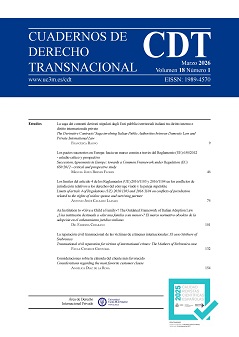
An Institution to «Give a Child a Family»? The Outdated Framework of Italian Adoption Law
DOI:
https://doi.org/10.20318/cdt.2026.10264Keywords:
adoption, best interests of the child, family law, civil unions, social parenthoodAbstract
The paper examines the Italian legal framework on adoption, highlighting both its structural and subjective limitations, which undermine its full adherence to the principle of the best interests of the child. Despite the solidaristic rationale underlying Law No. 184 of 1983, the rigid dichotomy between foster care and adoption fails to reflect the complexity of contemporary family dynamics, particularly in situations of semi-abandonment, where emotional ties with the biological family persist despite parental inadequacy. Moreover, full adoption remains conditional upon marriage, excluding unmarried couples, same-sex unions and single persons, in tension with constitutional and conventional principles of equality and family pluralism. In the absence of comprehensive legislative reform, courts have sought to address these gaps through flexible interpretations, especially via special adoption, yet such judicial solutions lack the legal certainty that only systematic legislative intervention—also in light of comparative European experiences—can provide.
Downloads
Downloads
Published
-
Abstract311
-
PDF 897
Issue
Section
License

This work is licensed under a Creative Commons Attribution-NonCommercial-NoDerivatives 4.0 International License.
Se permite que los autores de los trabajos de investigación publicados en la Revista los reproduzcan en otros sitios siempre que se haga mención de que han sido previamente publicados en Cuadernos de Derecho Transnacional (CDT).
Los documentos incluyen la licencia Creative Commons 4.0: Atribución–No Comercial–Sin Obra Derivada (CC BY-NC-ND 4.0).