Análisis de temas durante crisis sanitarias
Cobertura mediática de las vacunas COVID-19 en México
DOI:
https://doi.org/10.20318/recs.2026.9693Palabras clave:
Pandemias, COVID-19, Noticias, Procesamiento de Lenguaje NaturalResumen
Introducción: Este estudio examina la evolución de los marcos temáticos en la cobertura mediática mexicana sobre las vacunas contra la COVID-19 entre 2020 y 2021, dado que las narrativas de los medios configuran la percepción pública y la confianza institucional durante crisis sanitarias. Objetivos: La investigación busca identificar y analizar los temas dominantes en la cobertura de vacunas contra la COVID-19 en México y seguir su evolución temporal. Metodología: Se analizó un corpus de 43.358 artículos de periódicos nacionales relevantes en México. Utilizando Latent Dirichlet Allocation (LDA), una técnica de modelado de temas del Procesamiento de Lenguaje Natural, se categorizó trimestralmente el contenido de las noticias para mapear la evolución temática a lo largo del tiempo. Resultados: Se identificaron cinco temas principales: crisis sanitaria y económica global, relaciones internacionales, gestión de la pandemia a nivel estatal, respuestas institucionales a grupos sociales y política nacional de salud pública. Los hallazgos muestran una progresión clara desde marcos centrados en la crisis global hacia discusiones de política más localizadas. Conclusión: El estudio destaca cómo la cobertura mediática evoluciona en respuesta a cambios sociales y epidemiológicos, ofreciendo información valiosa para el diseño de estrategias de comunicación sanitaria oportunas y culturalmente apropiadas.
Descargas
Referencias
Abhyankar, P., O’Connor, D. B., & Lawton, R. (2007). The role of message framing in promoting MMR vaccination: Evidence of a loss frame advantage. Psychology, Health & Medicine, 13(1), 1-16. https://doi.org/10.1080/13548500701235732
Afrin, L. B., Dempsey, T. T., & Weinstock, L. B. (2022). Post-HPV-vaccination mast cell activation syndrome: Possible vaccine triggered escalation of undiagnosed pre-existing mast cell disease? Vaccines, 10(1), 127. https://doi.org/10.3390/vaccines10010127
Aghazadeh, S. A., & Aldoory, L. (2023). Health communication theory in public relations. In C. H. Botan & E. J. Sommerfeldt (Eds.), Public relations theory III (pp. 395-411). Routledge. https://doi.org/10.4324/9781003141396-27
Alhassan, R. Owusu-Agyei, S., Ansah, E., & Gyapong, M. (2021). COVID -19 vaccine uptake among health care workers in Ghana: a case for targeted vaccine deployment campaigns in the global south. Human Resources for Health, 19, 1-12. https://doi.org/10.1186/s12960-021-00657-1
Angulo-Giraldo, M., & Requena, M. (2025). La vacunación contra la COVID-19 en debate: discursos en medios digitales de México, Brasil y Perú (2020-2021). Comunicación y Medios, 34(52), 55-69. https://doi.org/10.5354/0719-1529.2025.77802
Anwar, A., Malik, M., Raees, V., & Anwar, A. (2020). Role of mass media and public health communications in the COVID-19 pandemic. Cureus, 12(9), e10453. https://doi.org/10.7759/cureus.10453
Bermeo, Í., Riofrio, C., Morales, A., & Rojas, L. (2024). Evolución de las técnicas de comunicación en la investigación en salud pública: una revisión crítica de la literatura. Revista Imaginario Social, 7(3). https://doi.org/10.59155/is.v7i3.219
Bharti, N., & Sismondo, S. (2022). Political prescriptions: three pandemic stories. Science, Technology, & Human Values, 49(2), 371 402. https://doi.org/10.1177/01622439221123831
Bhatti, S., Billinson, P., Cornell, L., Das, A., Gammon, C., Kelly, L., ... & Kristiansen, S. (2022). A country comparative analysis of international print media’s framing of the COVID-19 pandemic. International Journal of Communication, 16, 27. https://ijoc.org/index.php/ijoc/article/download/17990/3701
Blei, D., Ng, A., & Jordan, M. (2003). Latent Dirichlet allocation. Journal of Machine Learning Research, 3, 993-1022. https://jmlr.csail.mit.edu/papers/v3/blei03a.html
Catalán-Matamoros D.,& Langbecker A. (2023). Cómo ha cambiado la comunicación durante la pandemia covid-19: La prensa española ante las vacunas. Estudios sobre el Mensaje Periodístico, 29(3), 555-566. https://doi.org/10.5209/esmp.84698
Catalán-Matamoros D., Langbecker A., & Elías, C. (2024). Investigación sobre comunicación en COVID-19 y principales hallazgos. (2024). Revista Española de Comunicación en Salud, 67-77. https://doi.org/10.20318/recs.2024.8325
Comisión Económica para América Latina y el Caribe (CEPAL). (2023). Panorama social de América Latina y el Caribe 2022: La transformación de la educación como base para el desarrollo sostenible. Naciones Unidas. https://www.cepal.org/es/publicaciones/48518-panorama-social-america-latina-caribe-2022-la-transformacion-la-educacion-como
Comisión Federal para la Protección contra Riesgos Sanitarios (COFEPRIS). (2022). Vacunas COVID-19 autorizadas para uso de emergencia [COVID-19 vaccines authorized for emergency use]. Gobierno de México. https://www.gob.mx/cofepris/accionesy-programas/vacunas-covid-19-autorizadas
CONAHCYT. (2021, April 13). México advances in the development of the “Patria” vaccine against COVID-19. SECIHTI. https://secihti.mx/mexico-avanza-en-el-desarrollo-de-la-vacuna-patria-contra-la-COVID-19/
Cortez-Gómez, R., Muñoz-Martínez, R., & Ponce-Jiménez, P. (2020). Structural vulnerability of Indigenous peoples to COVID-19. Boletín sobre COVID, 1(7-8), 7-10. http://dsp.facmed.unam.mx/wp-content/uploads/2022/03/COVID-19-No.7-8-04-Vulnerabilidad estructural-de-los-pueblos-indigenas.pdf
Cruz-Mendoza, E. (2026). Estructura algorítmica y dinámicas de interacción en YouTube durante la pandemia. Global Media Journal México, 23(44), 57-80. https://doi.org/10.29105/gmjmx23.44-553
Cruz-Mendoza, E., Levin, L., & Milillo, M. (2025). Noticias y vacunas Covid-19 en Argentina: Un análisis de modelación temática. Austral Comunicación, 14(3), e01432. https://doi.org/10.26422/aucom.2025.1403.cru
Cuberli, M., & Albardonedo, M. (2020). The discursive construction of the COVID-19 vaccine on an Argentine digital news portal (La construcción discursiva de la vacuna contra el COVID-19 en un portal digital de noticias argentino). Revista Latinoamericana de Ciencias de la Comunicación, 19(35). https://revista.pubalaic.org/index.php/alaic/article/view/668/675
Da, C., Duan, Y., Ji, Z., Chen, J., Xia, H., Weng, Y., ... & Cai, T. (2024). Assessing the needs of patients with breast cancer and their families across various treatment phases using a Latent Dirichlet Allocation model: A text-mining approach to online health communities. Supportive Care in Cancer, 32(5), 314. https://doi.org/10.1007/s00520-024-08513-3
De Gennaro, F. (2025). Representaciones mediáticas en torno a la vacunación contra la COVID-19: tematizaciones periodísticas. Grado Cero. Revista de Estudios en Comunicación, (7). https://publicacionescientificas.uces.edu.ar/index.php/grado/article/view/1786
Demonte, F., Bruno, D., Lozano, L., Mena, M., & Pereira, A. (2024). Public conversation about vaccines during the COVID-19 pandemic in Argentina, 2021-2022 (Conversación pública sobre vacunas en la pandemia de Covid-19 en Argentina, 2021-2022). Salud Colectiva, 20, e4580-e4580. https://doi.org/10.18294/sc.2024.4580
Dickinson, R., Makowski, D., van Marwijk, H., & Ford, E. (2024). Exploring the Role of News Outlets in the Rise of a Conspiracy Theory: Hydroxychloroquine in the Early Days of COVID-19. COVID, 4(12), 1873-1896. https://doi.org/10.3390/COVID4120132
Ejaz, W., Ittefaq, M., & Jamil, S. (2023). Politics triumphs: A topic modeling approach for analyzing news media coverage of climate change in Pakistan. Journal of Science Communication, 22(1), A02. https://doi.org/10.22323/2.22010202
Entman, R. (1993). Framing: Toward clarification of a fractured paradigm. Journal of Communication, 43(4), 51-58. https://doi.org/10.1111/j.1460-2466.1993.tb01304.x
Escudero, X., Guarner, J., Galindo-Fraga, A., Escudero-Salamanca, M., Alcocer-Gamba, M., & Río, C. (2020). The SARS-CoV-2 (COVID-19) pandemic: Current situation and implications for Mexico. Archivos de Cardiología de México, 90, 7-14. https://www.scielo.org.mx/scielo.php?pid=S1405-99402020000500007&script=sci_arttext
Estrella-Pacheco, M. (2023). Aumento de investigaciones en comunicación sobre vacunas en revistas WoS. (2023). Revista Española de Comunicación en Salud, 14(1), 81-86. https://doi.org/10.20318/recs.2023.7059
Ferguson, E., & Gallagher, L. (2010). Message framing with respect to decisions about vaccination: The roles of frame valence, frame method, and perceived risk. British Journal of Psychology, 98(4), 667-680. https://doi.org/10.1348/000712607X190692
Freimuth, V. S., & Quinn, S. C. (2004). The contributions of health communication to eliminating health disparities. American journal of public health, 94(12), 2053-2055. https://doi.org/10.2105/ajph.94.12.2053
García, J., Delfín, F., & Morales, T. (2022). Increase in inequality due to the COVID-19 pandemic in Mexico. Revista Ciencia Administrativa, (2). https://www.uv.mx/iiesca/files/2023/08/06_2022_2.pdf
Glik, D. (2007). Risk communication for public health emergencies. Annual Review of Public Health, 28(1), 33-54. https://doi.org/10.1146/annurev.publhealth.28.021406.144123
Günther, L., Gaertner, M., & Zeitz, J. (2020). Framing as a concept for health communication: A systematic review. Health Communication, 36(7), 891-899. https://doi.org/10.1080/10410236.2020.1723048
Hagg, L. J., Merkouris, S. S., O’Dea, G. A., Francis, L. M., Greenwood, C. J., Fuller-Tyszkiewicz, M., ... & Youssef, G. J. (2022). Examining analytic practices in latent Dirichlet allocation within psychological science: Scoping review. Journal of Medical Internet Research, 24(11), e33166. https://doi.org/10.2196/33166
Holton, A., Weberling, B., Clarke, C., & Smith, M. (2012). The blame frame: Media attribution of culpability about the MMR–autism vaccination scare. Health communication, 27(7), 690-701. https://doi.org/10.1080/10410236.2011.633158
Hung, S., & Chang, S. (2023). Framing the virus: The political, economic, biomedical, and social understandings of COVID-19 in Taiwan. Technological Forecasting and Social Change, 188, 122276. https://doi.org/10.1016/j.techfore.2022.122276
Instituto Nacional de Transparencia, Acceso a la Información y Protección de Datos Personales (INAI). (2020). Semáforo de riesgo epidemiológico COVID-19 [Epidemiological risk traffic light COVID-19]. https://micrositios.inai.org.mx/conferenciasCOVID 19tp/?page_id=7816
Ishikawa, H., & Kiuchi, T. (2010). Health literacy and health communication. BioPsychoSocial Medicine, 4, 1-5. https://doi. org/10.1186/1751-0759-4-18
Kim, K. J., Shin, D. H., & Yoon, H. (2017). Information tailoring and framing in wearable health communication. Information Processing & Management, 53(2), 351-358. https://doi.org/10.1016/j.ipm.2016.11.005
Kohring, M., & Matthes, J. (2002). The face(t)s of biotech in the nineties: How the German press framed modern biotechnology. Public Understanding of Science, 11(2), 143. https://iopscience.iop.org/article/10.1088/0963-6625/11/2/304/meta
Li, Y., Rapkin, B., Atkinson, T. M., Schofield, E., & Bochner, B. H. (2019). Leveraging Latent Dirichlet Allocation in processing free-text personal goals among patients undergoing bladder cancer surgery. Quality of Life Research, 28, 1441-1455. https://doi.org/10.1007/s11136-019-02132-w
Lomelí-Vanegas, L. (2020). The health system challenges in Mexico. Economía UNAM, 17(51), 16-27. https://repositorio.cepal.org/ bitstreams/a8afc43b-0009-41a9-871c-7b20534567ed/download#page=196
Mach, K. J., Salas, R., Pentz, B., Taylor, J., Costa, C. A., Cruz, S. G., ... & Klenk, N. (2021). News media coverage of COVID-19 public health and policy information. Humanities and Social Sciences Communications, 8(1). https://doi.org/10.1057/s41599-021-00900-z
Mahato, P., Adhikari, B., Marahatta, S., Bhusal, S., Kunwar, K., Yadav, R., ... & van Teijlingen, E. (2023). Perceptions around COVID-19 and vaccine hesitancy: A qualitative study in Kaski district, Western Nepal. PLOS Global Public Health, 3(2), e0000564. https://doi.org/10.1371/journal.pgph.0000564
Milutinović, I. (2021). Media framing of the COVID-19 pandemic in the transitional regime of Serbia: Exploring discourses and strategies. Media, Culture & Society, 43(7), 1311-1327. https://doi.org/10.1177/0163443720986003
Montagni, I., Ouazzani-Touhami, K., Mebarki, A., Texier, N., Schück, S., Tzourio, C., & Confins Group. (2021). Acceptance of a COVID-19 vaccine is associated with ability to detect fake news and health literacy. Journal of Public Health, 43(4), 695-702. https://doi.org/10.1093/pubmed/fdab028
Moran, M. B.., Lucas, M., Everhart, K., Morgan, A., & Prickett, E. (2016). What makes anti-vaccine websites persuasive? A content analysis of techniques used by anti-vaccine websites to engender anti-vaccine sentiment. Journal of Communication in Healthcare, 9(3), 151-163. https://doi.org/10.1080/17538068.2016.1235531
Morejón-Llamas, N. (2023). Características y ejes discursivos de la desinformación y el proceso de fact-checking sobre las vacunas COVID-19 en Latinoamérica . (2023). Revista Española de Comunicación en Salud, 47-61. https://doi.org/10.20318/recs.2023.7005
Mutua, S. N., & Oloo, D. (2020). Online news media framing of the COVID-19 pandemic: Probing the initial phases of the disease outbreak in international media. European Journal of Interactive Multimedia and Education, 1(2), e02006. https://doi.org/10.30935/ejimed/8402
Nájera, H., & Huffman, C. (2021). The COVID-19 Pandemic and Poverty in Mexico in 2020. PUED-UNAM. http://www.pued.unam.mx/export/sites/default/archivos/COVID/DocumentoDivulgacion_PobrezaCOVID2021_Final.pdf“
Neuhauser, L., & Kreps, G. L. (2003). Rethinking communication in the e-health era. Journal of health psychology, 8(1), 7-23. https://doi.org/10.1177/1359105303008001426
Okorie, N. (2022). Global media framing, COVID-19, and the issue of vaccination: An empirical inquisition. Health Promotion Perspectives, 12(2), 186-191. https://doi.org/10.34172/hpp.2022.23
Olivera-Martínez, G., & García-Andrés, A. (2021). Hospital infrastructure and medical personnel of the Public Health System in Mexico during the COVID-19 pandemic. Ciencias Administrativas. Teoría y Praxis, 17(2), 85-105. https://cienciasadmvastyp.uat.edu.mx/index.php/ACACIA/article/view/288
PAHO. (2020, October 5). Access to the COVID-19 vaccine through the COVAX mechanism. Retrieved from https://www.paho.org/ es/noticias/5-10-2020-acceso-vacuna-contra-COVID-19-mediante-mecanismo-covax
Pennisi, F., Genovese, C., & Gianfredi, V. (2024). Lessons from the COVID-19 pandemic: promoting vaccination and public health resilience, a narrative review. Vaccines, 12(8), 891. https://doi.org/10.3390/vaccines12080891
Penţa, M. A., & Băban, A. (2017). Message framing in vaccine communication: A systematic review of published literature. Health Communication, 33(3), 299-314. https://doi.org/10.1080/10410236.2016.1266574
Quinn, S., Parmer, J., Freimuth, V., Hilyard, K., Musa, D., & Kim, K. (2013). Exploring communication, trust in government, and vaccination intention later in the 2009 H1N1 pandemic: results of a national survey. Biosecurity and bioterrorism: biodefense strategy, practice, and science, 11(2), 96-106. https://doi.org/10.1089/bsp.2012.0048
Ramamoorthy, T., & Mappillairaju, B. (2023). Tweet topics on cancer among Indian Twitter users—Computational approach using latent Dirichlet allocation topic modeling. Journal of Computational Social Science, 6(2), 1033-1054. https://doi.org/10.1007/s42001 023-00222-x
Rodelo, F. V. (2021). Framing of the Covid-19 pandemic and its organizational predictors. Cuadernos.info, (50), 91-112. https://doi.org/10.7764/cdi.50.37525
Rovetta, A., & Castaldo, L. (2021). Influence of mass media on Italian web users during the COVID-19 pandemic: infodemiological analysis. JMIRx med, 2(4), e32233. https://xmed.jmir.org/2021/4/e32233
Rudd, R., Anderson, J. E., Oppenheimer, S., & Nath, C. (2007). Health literacy: An update of medical and public health literature. In J. Comings, B. Garner, & C. Smith (Eds.), Review of adult learning and literacy: Connecting research, policy, and practice (Vol. 7). Routledge.
Salas, C., Quintana, L., Mendoza, M. Á., & Valdivia, M. (2020). Income distribution and poverty in Mexico during the COVID-19 pandemic. El trimestre económico, 87(348), 929-962. https://www.scielo.org.mx/scielo.php?pid=S2448-718X2020000400929&script=sci_arttext
Schwarz, A., Alpers, F., Wagner-Olfermann, E., & Diers-Lawson, A. (2023). The global study of COVID news: Scope, findings, and implications of quantitative content analyses of the COVID-19 news coverage in the first two years of the pandemic. Health Communication, 39(8), 1568-1581. https://doi.org/10.1080/10410236.2023.2226932
Secretaría de Salud. (2021). Política nacional de vacunación contra el virus SARS-CoV-2 para la prevención de la COVID-19 en México: Documento rector [National vaccination policy against the SARS-CoV-2 virus for the prevention of COVID-19 in Mexico: Guideline document]. Gobierno de México. https://www.gob.mx/salud
Solvoll, M., & Høiby, M. (2023). Framing of the COVID-19 pandemic: A case study of Norwegian broadcasting news-and debate programs. MedieKultur: Journal of Media and Communication Research, 38(73), 006-027. https://doi.org/10.7146/mk.v38i73.131934
Sprengholz, P., Henkel, L., Böhm, R., & Betsch, C. (2023). Historical narratives about the COVID-19 pandemic are motivationally biased. Nature, 623(7987), 588-593. https://doi.org/10.1038/s41586-023-06674-5
Su, Z., McDonnell, D., Li, X., Bennett, B., Šegalo, S., Abbas, J., ... & Xiang, Y. T. (2021). COVID-19 vaccine donations—vaccine empathy or vaccine diplomacy? A narrative literature review. Vaccines, 9(9), 1024. https://doi.org/10.3390/vaccines9091024
Suárez, V., Quezada, M., Ruiz, S., & De Jesús, E. (2020). Epidemiology of COVID-19 in Mexico: From February 27 to April 30, 2020. Revista Clínica Española, 220(8), 463-471. https://www.sciencedirect.com/science/article/pii/S0014256520301442
Torres-Toledano, M., Granados-García, V., López-Tapia, J. D. J., Miguel-Tiburcio, E. T., Flores, Y. N., Aracena-Genao, B., & Ramírez Palacios, P. (2023). Direct medical costs of COVID-19 care during the first year of the pandemic in a converted hospital. Gaceta Médica de México, 159(3), 175-183. https://www.scielo.org.mx/scielo.php?pid=S0016-38132023000300175&script=sci_arttext
Tran, B. X., Latkin, C. A., Sharafeldin, N., Nguyen, K., Vu, G. T., Tam, W. W., ... & Ho, R. C. (2019). Characterizing artificial intelligence applications in cancer research: A latent Dirichlet allocation analysis. JMIR Medical Informatics, 7(4), e14401. https://doi. org/10.2196/14401
Viswanath, K., Bekalu, M., Dhawan, D., Pinnamaneni, R., Lang, J., & McLoud, R. (2021). Individual and social determinants of COVID-19 vaccine uptake. BMC Public Health, 21(1), 818. https://doi.org/10.1186/s12889-021-10862-1
Waisbord, S. (2010). When health is the deadline: Dengue fever, AH1N1 flu and media-epidemic cycles. Folios, Revista de la Facultad de Comunicaciones y Filología, (23), 93-103. https://revistas.udea.edu.co/index.php/folios/article/view/11786
WHO. (2020a, February 12). Experts and funding entities worldwide set priorities for COVID-19 research. Retrieved from https://www. who.int/es/news/item/12-02-2020-world-experts-and-funders-set-priorities-for-COVID-19-research
WHO. (2020b, October 27). Launch of the collective access to technology against COVID-19 (C-TAP). Retrieved from https://www.who.int/es/publications/m/item/c-tap-a-concept-paper
Xue, J., Chen, J., Chen, C., Zheng, C., Li, S., & Zhu, T. (2020). Public discourse and sentiment during the COVID-19 pandemic: Using Latent Dirichlet Allocation for topic modeling on Twitter. PLOS One, 15(9), e0239441. https://doi.org/10.1371/journal.pone.0239441
Yakunin, K., Mukhamediev, R. I., Zaitseva, E., Levashenko, V., Yelis, M., Symagulov, A., ... & Gopejenko, V. (2021). Mass Media as a Mirror of the COVID-19 Pandemic. Computation, 9(12), 140. https://doi.org/10.3390/computation9120140
Yuan, X., Schuchard, R. J., & Crooks, A. T. (2019). Examining emergent communities and social bots within the polarized online vaccination debate in Twitter. Social Media + Society, 5(3). https://doi.org/10.1177/2056305119865465
Zhou, S., Kan, P., Huang, Q., & Silbernagel, J. (2023). A guided latent Dirichlet allocation approach to investigate real-time latent topics of Twitter data during Hurricane Laura. Journal of Information Science, 49(2), 465-479. https://doi.org/10.1177/0165551521100772
Zunino, E. (2022). Brechas y concentración de la información: un estudio sobre agendas, encuadres y consumos de noticias sobre vacunas en el marco del Covid-19 en la Argentina (Gaps and concentration of information: a study on agendas, frames, and news consumption about vaccines in the context of COVID-19 in Argentina). Revista de Comunicación, 21(1), 469-495. https://doi.org/10.26441/RC21.1-2022-A24
Zunino, E., & Arcangeletti, A. (2020). La cobertura mediática de la COVID-19 en la Argentina: un estudio sobre el tratamiento informativo de la pandemia en los principales medios online del país. Prácticas de Oficio. Investigación y reflexión en Ciencias Sociales, (25), 18-18. https://revistas.ungs.edu.ar/index.php/po/article/view/31
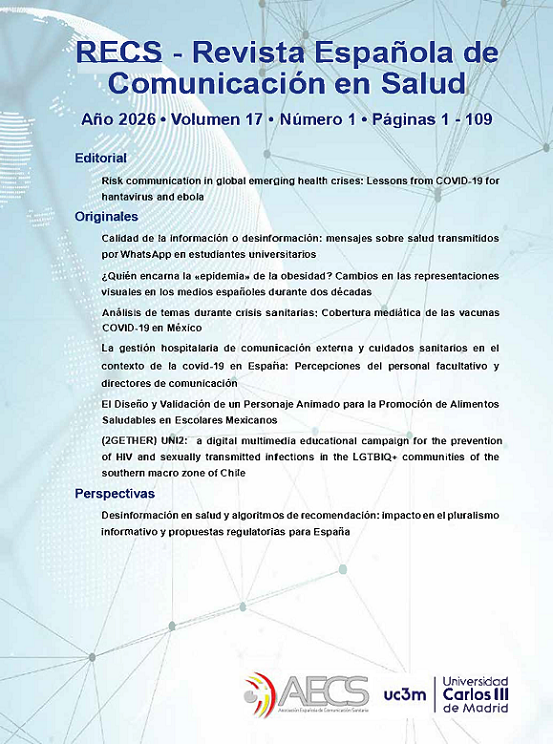
Descargas
Publicado
-
Resumen247
-
PDF (inglés)376
Número
Sección
Licencia
Derechos de autor 2026 Erick Cruz-Mendoza, Oscar Fontanelli Espinosa

Esta obra está bajo una licencia Creative Commons Reconocimiento-SinObraDerivada 3.0 Unported.
Los textos publicados en esta revista están –si no se indica lo contrario– bajo una licencia Reconocimiento-Sin obras derivadas 3.0 España de Creative Commons. Puede copiarlos, distribuirlos y comunicarlos públicamente siempre que cite su autor y la revista y la institución que los publica y no haga con ellos obras derivadas. La licencia completa se puede consultar en: http://creativecommons.org/licenses/by-nd/3.0/es/deed.es
Los derechos de autor pertenecen al autor de la obra por el mero hecho de su creación:
· Los derechos de contenido moral son irrenunciables e inalienables.
· Los derechos de contenido económico, o derechos de explotación, pueden ser cedidos a terceros como ocurre con los trabajos publicados, en los que el autor cede parte o la totalidad de estos derechos a la editorial.
El autor puede autoarchivar sus artículos en un repositorio institucional, siempre que se cite su publicación en esta revista.