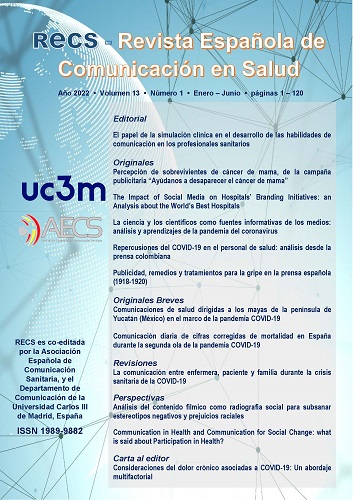
Perception of breast cancer survivors of the advertising campaign "Help us make breast cancer disappear"
DOI:
https://doi.org/10.20318/recs.2022.6232Keywords:
breast cancer, phenomenology, qualitative research, social promotion, advertisingAbstract
Introduction: There is a growing trend for brands to address social issues and, based on this, consumers generate different perceptions. Aim: To analyze how women who have overcome breast cancer perceive the advertising campaign “Help us make breast cancer disappear” by Oncosalud. Methodology: The approach was phenomenological. The semi-structured interview technique was used, in which the perceptions of fifteen women who overcame this disease were analyzed. Results: The results indicate that breast cancer survivors perceive advertising positively on this topic. They demand that, if the brand is to carry out a campaign on such a sensitive issue, the message should be developed as neatly as possible. Conclusions: Their difficult life experience as cancer patients gives them a very particular vision about what should be shown in the audiovisual messages as well as through social media.
Downloads
References
Abu Zayyad, H., Obeidat, Z., Alshurideh, M., Abuhashesh, M., Maqableh, M., & Masa’deh, R. (2020). Corporate social responsibility and patronage intentions: The mediating effect of brand credibility. Journal of Marketing Communications, 1–24. https://doi.org /10.1080/13527266.2020.1728565
Alhawamdeh, A. K. (2020). The relationship between media marketing advertising and encouraging Jordanian women to conduct early detection of breast cancer. European Journal of Business and Management, 12(12), 130–135. https://doi. org/10.7176/ejbm/12-12-11
Aluwihare-Samaranayake, D. (2012). Ethics in qualitative research: A view of the participants and researchers world from a critical standpoint. International Journal of Qualitative Methods, 11(2), 64–81. https://doi.org/10.1177/160940691201100208
Álvarez, J., Sáchica, J., & Villalba, J. (2018). Percepción de los pacientes acerca de la empatía de las enfermeras en Monterrey (México). Revista Española de Comunicación en Salud, 9(1), 46. https://doi.org/10.20318/recs.2018.4252
Ads of the world (2020). I touch myself project. The woman behind the voice. Disponible: https://www.adsoftheworld.com/media/film/i_touch_myself_project_the_woman_behind_the_voice
Ads of the world (2019). Mapfre Bralert. Disponible: https://www.adsoftheworld.com/media/digital/mapfre_bralert
Belk, R. (2017). Qualitative research in advertising. Journal of Advertising, 46(1), 36–47. https://doi.or g/10.1080/00913367.2016.1201025
Bhaduri, G., & Ha-Brookshire, J. (2017). The role of brand schemas, information transparency, and source of message on apparel brands’ social Rev Esp Comun Salud // 15 16 // Rocha-Villanueva, Arbaiza, & Gallardo-Echenique responsibility communication. Journal of Marketing Communications, 23(3), 293–310. https://doi.org/1 0.1080/13527266.2015.1040441
Bleiker, J., Morgan-Trimmer, S., Knapp, K., & Hopkins, S. (2019). Navigating the maze: Qualitative research methodologies and their philosophical foundations. Radiography, 25(1), S4–S8. https:// doi.org/10.1016/j.radi.2019.06.008
Broekhuizen, T., Emrich, O., Gijsenberg, M., Broekhuis, M., Donkers, B., & Sloot, L. (2019). Digital platform openness: Drivers, dimensions and outcomes. Journal of Business Research, 1–13. https://doi. org/10.1016/j.jbusres.2019.07.001
Butrina, P., Le Vine, S., Henao, A., Sperling, J., & Young, S. (2020). Municipal adaptation to changing curbside demands: Exploratory findings from semi-structured interviews with ten U.S. cities. Transport Policy, 92, 1–7. https://doi.org/10.1016/j.tranpol.2020.03.005
Carr, C., & Hayes, R. (2015). Social media: Defining, developing, and divining. Atlantic Journal of Communication, 23(1), 46–65. https://doi.org/10.1 080/15456870.2015.972282
Chiang, K.-P., & Jackson, A. (2016). The impact of health literacy on involvement and attitude toward pharmaceutical print ads. International Journal of Healthcare Management, 9(1), 47–57. https://doi. org/10.1179/2047971915Y.0000000015
Chuah, S., El-Manstrly, D., Tseng, M.-L., & Ramayah, T. (2020). Sustaining customer engagement behavior through corporate social responsibility: The roles of environmental concern and green trust. Journal of Cleaner Production, 262, 1–15. https://doi. org/10.1016/J.JCLEPRO.2020.121348
Código. (2019). Oncosalud busca que la gente la ayude a desaparecer. Disponible: https:// codigo.pe/oncosalud-busca-que-la-gente-la-ayudea-desaparecer/
Creswell, J. W. (2014). Research design: Qualitative, quantitative, and mixed methods approaches (4th ed.). SAGE Publications, Inc.
Dekker, R., Van den Brink, P., & Meijer, A. (2019). Social media adoption in the police: Barriers and strategies. Government Information Quarterly, 37(2), 1–9. https://doi.org/10.1016/j.giq.2019.101441
Dolan, P., & Tsuchiya, A. (2011). Determining the parameters in a social welfare function using stated preference data: An application to health. Applied Economics, 43(18), 2241–2250. https://doi. org/10.1080/00036840903166244
Eddles-Hirsch, K. (2015). Phenomenology and educational research. International Journal of Advanced Research, 3(8), 251–260. Disponible: http://www. journalijar.com/article/5631/phenomenology-andeducational-research/
Farrugia, B. (2019). WASP (write a scientific paper): Sampling in qualitative research. Early Human Development, 133, 69–71. https://doi.org/10.1016/j. earlhumdev.2019.03.016
Fletcher-Brown, J., Pereira, V., & Nyadzayo, M. (2017). Health marketing in an emerging market: The critical role of signaling theory in breast cancer awareness. Journal of Business Research, 86, 416–434. https://doi.org/10.1016/j.jbusres.2017.05.031
Font, X., & Lynes, J. (2018). Corporate social responsibility in tourism and hospitality. Journal of Sustainable Tourism, 26(7), 1027–1042. https://doi.org/10.1080/ 09669582.2018.1488856
Harvey, J. A., & Strahilevitz, M. A. (2009). The Power of Pink: Cause-Related Marketing and the Impact on Breast Cancer. Journal of the American College of Radiology, 6(1), 26–32. https://doi.org/10.1016/j. jacr.2008.07.010
Heimann, A., Ingold, P., & Kleinmann, M. (2019). Tell us about your leadership style: A structured interview approach for assessing leadership behavior constructs. Leadership Quarterly, 30(6), 101364. https://doi.org/10.1016/j.leaqua.2019.101364
Hills, S., Walker, M., & Barry, A. (2019). Sport as a vehicle for health promotion: A shared value example of corporate social responsibility. Sport Management Review, 22(1), 126–141. https://doi.org/10.1016/j. smr.2018.10.001
Hsiang, C., Yu, L., & Wen, C. (2021). Does family business affect the relationship between corporate social responsibility and brand value? A study in different industry Taiwan. Asia Pacific Management Review, 1–13. https://doi.org/10.1016/j. apmrv.2021.04.002
Instituto Nacional de Enfermedades Neoplásicas (INEN). (2009). Casos nuevos de cáncer registrados en INEN, periodo 2009-2018 (ambos sexos). 2018, 1–3. Disponible: https://portal.inen.sld.pe/wpcontent/uploads/2019/12/INEN-2009-2018.pdf
Jean, A., Wang, X., & Suntu, S. (2020). Corporate social responsibility in Madagascar: an investigation on Chinese companies. International Journal of Construction Management, 20(1), 29–38. https:// doi.org/10.1080/15623599.2018.1462442
Jing, Y., Peiyu, L., Xiaobing, T., & Wenfeng, L. (2018). Improved SIR advertising spreading model and its effectiveness in social network. Procedia Computer Science, 129, 215–218. https://doi.org/10.1016/j. procs.2018.03.044
Larrieta-Rubín de Celis, I., Fernández de BobadillaGüémez, S., Alonso-Almeida, M. del M., & VelascoBalmaseda, E. (2017). Women’s occupational health and safety management: An issue for corporate social responsibility. Safety Science, 91, 61–70. https://doi.org/10.1016/j.ssci.2016.07.019
Lee, J. & Rim, H. (2018). Evolution of corporate social responsibility: A content analysis of United States magazine advertising, 1980–2009. Journal of Promotion Management, 24(4), 555–577. https:// doi.org/10.1080/10496491.2017.1380111
Lee, J., & Hong, I. (2016). Predicting positive user responses to social media advertising: The roles of emotional appeal, informativeness, and creativity. International Journal of Information Management, 36(3), 360–373. https://doi. org/10.1016/j.ijinfomgt.2016.01.001
Leon, R., Rodríguez-Rodríguez, R., Gómez-Gasquet, P., & Mula, J. (2020). Business process improvement and the knowledge flows that cross a private online social network: An insurance supply chain case. Information Processing and Management, 57(4), 1–16. https://doi.org/10.1016/j.ipm.2020.102237
Lubis, A. (2018). Corporate social responsibility in health sector: A case study in the government hospitals in Medan, Indonesia. Business: Theory and Practice, 19(9), 25–36. https://doi.org/10.3846/btp.2018.04
Mercado Negro. (2019, 5 de julio). Oncosalud: la marca que busca desaparecer. Mercado Negro. Disponible: https://www.mercadonegro.pe/marketing/ oncosalud-la-marca-que-busca-desaparecer/
Mehta, A. (2020). Qualitative research in male infertility. Urologic Clinics of NA, 47(2), 205–210. https://doi. org/10.1016/j.ucl.2019.12.007
Mekawie, N., & Hany, A. (2019). Understanding the factors driving consumers’ purchase intention of over the counter medications using social media advertising in Egypt. Procedia Computer Science, 164, 698– 705. https://doi.org/10.1016/j.procs.2019.12.238
Mendieta, G. (2015). Informantes y muestreo en investigación cualitativa. Investigaciones Andina, 17(30), 1148–1150. https://doi. org/10.33132/01248146.65
Michaelidou, N., Micevski, M., & Cadogan, J. W. (2020). Users’ ethical perceptions of social media research: Conceptualisation and measurement. Journal of Business Research, 112, 1–11. https://doi. org/10.1016/j.jbusres.2020.03.005
MINSA. (2020). Plan nacional para la prevención y control de cáncer de mama en el Perú 2017- 2021. 28. Disponible: http://bvs.minsa.gob.pe/local/MINSA/4234.pdf
Oncosalud. (2020). Nosotros. Disponible: https://www. oncosalud.pe/nosotros
Oncosalud. [Oncosalud]. (2013, Abril 8). Oncosalud 1 [Archivo de video]. Disponible: https://youtu.be/ jYErgzFCgdc
Oncosalud. [Oncosalud]. (2013, Junio 24). Testimonial Elba Briceño [Archivo de video]. Disponible: https:// youtu.be/Bs2TycLjJkI
Oncosalud. [Oncosalud]. (2015, Septiembre 2). Oncosalud - Tu lucha mi lucha [Archivo de video]. Disponible: https://youtu.be/MLBBWKtdfkM
Oncosalud. [Oncosalud]. (2019, Junio 27). Oncosalud 30 años [Archivo de video]. Disponible: https:// youtu.be/yDGMtnMrfb4
Oncosalud. [Oncosalud]. (2019, Octubre 17). Ayúdanos a desaparecer el cáncer de mama [Archivo de video]. Disponible: https://youtu.be/epq_-xFwBFU
Oncosalud. (2020). Que desaparezca el cáncer de mama. Disponible: https://marketing.oncosalud.pe/ cancer-de-mama-2019 Organización Mundial de la Salud (OMS, 2020). Cáncer. Disponible: https://www.who.int/es/health-topics/ cancer#tab=tab_1
Pomering, A., & Johnson, L. W. (2009). Constructing a corporate social responsibility reputation using corporate image advertising. Australasian Marketing Journal, 17(2), 106–114. https://doi. org/10.1016/j.ausmj.2009.05.006
Ritchie, J., Spencer, L., & O’Connor, W. (2003). Carrying out qualitative analysis. In J. Ritchie & J. Lewis (Eds.), Qualitative research practice: a guide for social science students and researchers (pp. 219–262). Sage Publications.
Smeele, H., Van der Does de Willebois, E. M., Eltahir, Y., De Bock, G., Van Aalst, V., & Jansen, L. (2019). Acceptance of contralateral reduction mammoplasty after oncoplastic breast conserving surgery: A semistructured qualitative interview study. The Breast, 45, 97–103. https://doi.org/10.1016/j.breast.2019.03.008
Stivala, A., Koskinen, J., Rolls, D. A., Wang, P., & Robins, G. L. (2016). Snowball sampling for estimating exponential random graph models for large networks. Social Networks, 47, 167–188. https:// doi.org/10.1016/j.socnet.2015.11.003
Sueldo, A. (2018). Mujer alerta. Campaña de prevención del cáncer de cuello uterino. [Universidad San Ignacio de Loyola]. https:// repositorio.usil.edu.pe/handle/usil/3097
Sun, X., Foscht, T., & Eisingerich, A. (2021). Does educating customers create positive word of mouth? Journal of Retailing and Consumer Services, 62, 1–9. https://doi.org/10.1016/j.jretconser.2021.102638
Te, V., Ford, P., & Schubert, L. (2019). Exploring social media campaigns against sugar-sweetened beverage consumption: A systematic search. Cogent Medicine, 6(1), 1–16. https://doi.org/10.1080/23312 05x.2019.1607432
Teal, R., Roberts, M., Harrigan, P., Clarkson, J., & Rosenberg, M. (2019). Leveraging spectator emotion: A review and conceptual framework for marketing health behaviors in elite sports. Sport Management Review, 23(2), 183–199. https://doi.org/10.1016/j. smr.2019.05.003
Texeira, A., Lopes, R., Azevedo, J., & Alves, D. (2017). Development and proposal of a reference tool for semi-structured interviews for the characterization of the management in mental health networks. Procedia Computer Science, 121, 511–518. https://doi.org/10.1016/j.procs.2017.11.068
Voorveld, H., van Noort, G., Muntinga, D., & Bronner, F. (2018). Engagement with social media and social media advertising: The differentiating role of platform type. Journal of Advertising, 47(1), 38–54. https:// doi.org/10.1080/00913367.2017.1405754
Xu, J. (2017). Moral emotions and self-construal in charity advertising: Communication on focus. Journal of Promotion Management, 23(4), 557–574. https:// doi.org/10.1080/10496491.2017.1297976
Xu, S., & Zhou, A. (2020). Hashtag homophily in twitter network: Examining a controversial cause-related marketing campaign. Computers in Human Behavior, 102, 87–96. https://doi.org/10.1016/j. chb.2019.08.006
Zarouali, B., Poels, K., Walrave, M., & Ponnet, K. (2018). ‘You talking to me?’ The influence of peer communication on adolescents’ persuasion knowledge and attitude towards social advertisements. Behaviour and Information Technology, 37(5), 502–516. https:// doi.org/10.1080/0144929X.2018.1458903
Downloads
Published
-
Abstract2455
-
PDF 1838
Issue
Section
License
All articles published in this journal –unless otherwise stated- are distributed under the terms of the Creative Commons Attribution-NoDerives (CC-BY-ND 3.0 ES) Spain 3.0 License, which allows others to copy, distribute and transmit in a public way as long as they credit the author(s), journal and institution that publish these articles, and provided that they are not altered or modified. The complete license can be consulted in: https://creativecommons.org/licenses/by/3.0/es/deed/.es
The copyright belongs to the manuscript’s author just on the basis of creating this work:
- Moral rights are undeniable and inalienable.
- Economic or exploitation rights can be transferred to third parties, as it occurs when articles are published and authors partially or totally transfer their exploitation rights to publishers
Authors can archive their own articles in an institutional repository as long as their publications are cited in this journal.