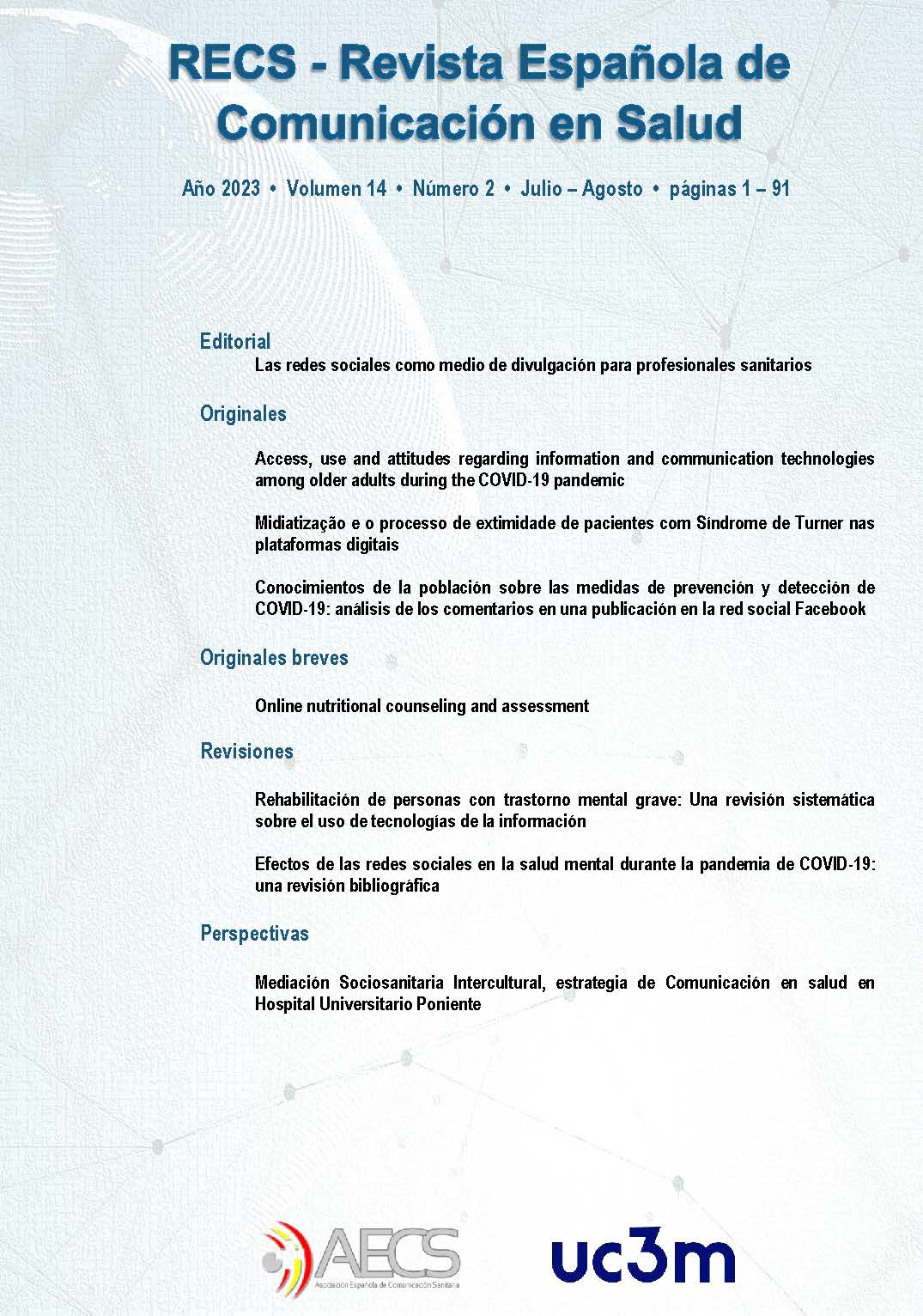
Effects of social networks on mental health during the COVID-19 pandemic
A literature review
DOI:
https://doi.org/10.20318/recs.2023.7703Keywords:
scientific communication, COVID-19, social networks, mental health, mental disordersAbstract
Introduction: empirical work on the use of social networks and mental health has gradually been published, so it is essential to understand it in the context of COVID-19 given the use of social networks and the mental health problems that resulted from the global pandemic. Objetive: to analyze the 91 empirical articles indexed in PubMed and WoS, which investigated the manifestations of mental health issues in social media and their relationship with COVID-19. Methodology: the study uses the literature review and includes the mental health topic analysed, objective of the article, methodology, region and country of the study, conclusions and their validity. Results: Asia and North America were the regions that published more articles. The most studied social media were Twitter (37.4%), Facebook (17.6%) and WeChat (14.3%). Twitter, Facebook or Instagram were rated positively as information tools (91%, 80% and 83.3% respectively), while WeChat and Weibo had lower percentages (45.6% and 50%). Conclusion: most articles have highlighted the positive use of social media as an information tool that helped to obtain real-time information on government plans and measures, which reduced the stress caused by the uncertainty of COVID-19.
Downloads
References
Al-Zaman, S. (2021). COVID-19-Related social media fake news in India. Journalism and Media, 2(1), 100–114. https://doi.org/10.3390/journalmedia2010007
Antheunis, M. L., Tates, K., & Nieboer, T. E. (2013). Patients’ and health professionals’ use of social media in health care: motives, barriers and expectations. Patient education and counseling, 92(3), 426-431. https://www.doi.org/10.1016/j. pec.2013.06.020
Ballesteros Herencia, C. (2020). La propagación digital del coronavirus: Midiendo el engagement del entretenimiento en la red social emergente TikTok. Revista Española de Comunicación en Salud, 171-185. https://doi.org/10.20318/recs.2020.5459
Barrientos-Báez, A., Martínez Sala, A. M., Altamirano, V. P., & Caldevilla Domínguez, D. (2021). Fake News: La pandemia de la COVID-19 y su cronología en el sector turístico. Historia y Comunicación Social, 26(Especial), 135-148. https://doi.org/10.5209/hics.74248
Cambronero Saiz, B., & Gómez Nieto, B. (2021). The use of social networks and their implication for health communication. A bibliographic review on the use of Twitter and cancer. Revista Interdisciplinar De Estudios De Comunicación Y Ciencias Sociales, (33), 377-392. https://doi.org/10.31921/doxacom.n33a868
Center for the Study of Traumatic Stress. (CSTS) (2020). Taking care of patients during Coronavirus outbreak: A guide for Psychiatrists. Bethesda, USA: Center for the Study of Traumatic Stress. https://bit.ly/3tIyYB7
Chand, A. A. (2021). Abuse of social media during COVID-19 pandemic in Fiji. International Journal of Surgery, 92, 106012. https://doi.org/10.1016/j.ijsu.2021.106012
Chen, S., Zhou, L., Song, Y., Xu, Q., Wang, P., Wang, K., Ge, Y., & Janies, D. (2021). A novel machine learning framework for comparison of viral COVID-19–Related Sina Weibo and Twitter Posts: Workflow Development and Content Analysis. Journal of medical Internet research, 23(1), e24889. https://www.doi.org/10.2196/24889
Chou, W. Y. S., Hunt, Y. M., Beckjord, E. B., Moser, R. P., & Hesse, B. W. (2009). Social media use in the United States: implications for health communication. Journal of medical Internet research, 11(4), e1249. https://www.doi.org/10.2196/jmir.1249
Deliyore Vega, M. R. (2021). Redes como espacio de comunicación para la educación virtual de estudiantes con discapacidad en Costa Rica en tiempos de pandemia. Historia y Comunicación Social, 26(Especial), 75-85. https://dx.doi.org/10.5209/hics.74243
De Angelis, G., Wells, G. A., Davies, B., King, J., Shallwani, S. M., McEwan, J., Cavallo, S., & Brosseau, L. (2018). The use of social media among health professionals to facilitate chronic disease self-management with their patients: A systematic review. Digital Health, 4, 2055207618771416. https://www.doi.org/10.1177/2055207618771416
EPIDAT (2014). Ayuda de Concordancia y consistencia. Disponible en: https://bit.ly/3G34gdX
Friedman, S. R., & Aral, S. (2001). Social networks, risk-potential networks, health, and disease. Journal of Urban Health, 78(3), 411-418. https://www.doi.org/10.1093/jurban/78.3.411
Fuentes, V. (2021). La pandemia aumentó los trastornos depresivos y la ansiedad en todo el mundo. Agencia SINC (Servicio de Información y Noticias Científicas). https://bit.ly/3iGARZQ
Gage-Bouchard, E. A., LaValley, S., Warunek, M., Beaupin, L. K., & Mollica, M. (2018). Is cancer information exchanged on social media scientifically accurate?. Journal of Cancer Education, 33(6), 1328-1332. https://doi .org/10.1007/s13187- 017-1254-z
Gutiérrez-Martín, A., & Tyner, K. (2012). Media education, media literacy and digital competence. Comunicar. Media Education Research Journal, 20(1), 31-39. http://dx.doi.org/10.3916/C38-2012-02-03
Huiling, Z. (2020). El papel irremplazable de los nuevos medios de comunicación en China en respuesta al COVID-19. Historia y comunicación social, 26(Especial), 53-59. https://dx.doi.org/10.5209/hics.74241
Levac, J., & O’Sullivan, T. (2010). Social media and its use in health promotion. Interdisciplinary Journal of Health Sciences, 1(1), 47-53. https://doi.org/10.18192/riss-ijhs.v1i1.1534
Liu, Q., Zheng, Z., Zheng, J., Chen, Q., Liu, G., Chen, S., Chu, B., Zhu, H., Akinwunmi, B., Huang, J., Zhang, C. J. P., & Ming, W. K. (2020). Health communication through news media during the early stage of the COVID-19 outbreak in China: Digital topic modeling approach. Journal of Medical Internet Research, 22(4), e19118. https://doi.org/10.2196/19118
Marroquín, B., Vine, V., & Morgan, R. (2020). Mental health during the COVID-19 pandemic: Effects of stay-at-home policies, social distancing behavior, and social resources. Psychiatry Research, (293), 113419. https://www.doi.org/10.1016/j. psychres.2020.113419
Moorhead, S. A., Hazlett, D., Harrison, L., Carroll, J. K., Irwin, A., & Hoving, C. (2013). A new dimension of health care: systematic review of the uses, benefits, and limitations of social media for health communication. Journal of medical Internet research, 15(4), e1933. https://www.doi.org/10.2196/jmir.1933
Obi-Ani, N. A., Anikwenze, C., & Isiani, M. C. (2020). Social media and the covid-19 pandemic: observations from Nigeria. Cogent Arts & Humanities, 7(1), 1799483. https://doi.org/10.1080/23311983.2020.1799483
Ribot Reyes, V. C., Chang Paredes, N., & González Castillo, A. L. (2020). Efectos de la Covid-19 en la salud mental de la población. Revista Habanera de Ciencias Médicas, 19(1). https://bit.ly/3sWvjRa
Rodrigues Abjaude, S. A., Borges Pereira, L., Barboza Zanetti, M. O., & Leira Pereira, L. R. (2020). How do social media influence mental health?. SMAD, Revista Eletrônica Saúde Mental Álcool Drog, 16(1), 1-3. https://dx.doi.org/10.11606/issn.1806-6976.smad.2020.0089
Santomauro, D. F., Herrera, A. M. M., Shadid, J., Zheng, P., Ashbaugh, C., Pigott, D. M., & Ferrari, A. J. (2021). Global prevalence and burden of depressive and anxiety disorders in 204 countries and territories in 2020 due to the COVID-19 pandemic. The Lancet, 398(10312), 1700-1712. https://www.doi.org/10.1016/S0140-6736(21)02143-7
Schultz, A., & Parikh, J. (2020). Keeping our services stable and reliable during the COVID-19 outbreak. Meta. https://bit. ly/35JJQqu
Sinnenberg, L., Buttenheim, A. M., Padrez, K., Mancheno, C., Ungar, L., & Merchant, R. M. (2017). Twitter as a tool for health research: a systematic review. American Journal of Public Health, 107(1), e1-e8. https://www.doi.org/10.2105/ AJPH.2016.303512
Skaik, R., & Inkpen, D. (2020). Using social media for mental health surveillance: a review. ACM Computing Surveys (CSUR), 53(6), 1-31. https://doi.org/10.1145/3422824
Smailhodzic, E., Hooijsma, W., Boonstra, A., & Langley, D. J. (2016). Social media use in healthcare: a systematic review of effects on patients and on their relationship with healthcare professionals. BMC health services research, 16(1), 1-14. https://doi.org/10.1186/s12913-016-1691-0
Su, Z., McDonnell, D., Wen, J., Kozak, M., Abbas, J., Šegalo, S., Li, X., Ahmad, J., Cheshmehzangi, A., Cai, Y., Yang, L., & Xiang, Y. T. (2021). Mental health consequences of COVID-19 media coverage: the need for effective crisis communication practices. Globalization and Health, 17(1), 1-8. https://doi.org/10.1186/s12992-020-00654-4
Tian, X., Yu, G., & He, F. (2016). An analysis of sleep complaints on Sina Weibo. Computers in Human Behavior, (62), 230-235. http://dx.doi.org/10.1016/j.chb.2016.04.014
Ulvi, O., Karamehic-Muratovic, A., Baghbanzadeh, M., Bashir, A., Smith, J., & Haque, U. (2022). Social Media Use and Mental Health: A Global Analysis. Epidemiologia, 3(1), 11-25. https://doi.org/10.3390/epidemiologia3010002
World Health Organization. (2020). Mental health and psychological considerations during the COVID-19 outbreak. Geneva: World Health Organization. https://bit.ly/3Mz2IsN
Wu, Y., Deng, M., Wen, X., Wang, M., & Xiong, X. (2020). Statistical analysis of dispelling rumors on Sina Weibo. Complexity, 2020. https://doi.org/10.1155/2020/3176593
Downloads
Published
-
Abstract5918
-
PDF 2223
-
PDF Apéndice 1 179
Issue
Section
License
All articles published in this journal –unless otherwise stated- are distributed under the terms of the Creative Commons Attribution-NoDerives (CC-BY-ND 3.0 ES) Spain 3.0 License, which allows others to copy, distribute and transmit in a public way as long as they credit the author(s), journal and institution that publish these articles, and provided that they are not altered or modified. The complete license can be consulted in: https://creativecommons.org/licenses/by/3.0/es/deed/.es
The copyright belongs to the manuscript’s author just on the basis of creating this work:
- Moral rights are undeniable and inalienable.
- Economic or exploitation rights can be transferred to third parties, as it occurs when articles are published and authors partially or totally transfer their exploitation rights to publishers
Authors can archive their own articles in an institutional repository as long as their publications are cited in this journal.
How to Cite
Funding data
-
Ministerio de Ciencia e Innovación
Grant numbers PID2022-136425OB-I00/