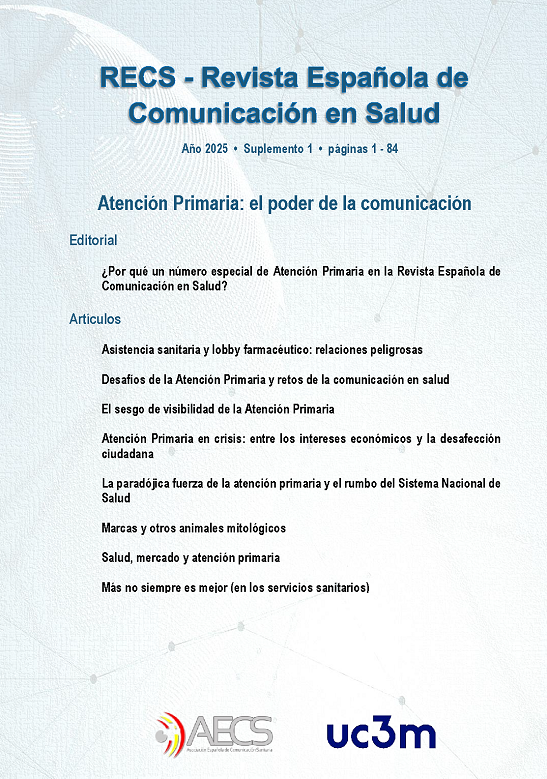
More is not always better (in health services)
DOI:
https://doi.org/10.20318/recs.2025.8793Keywords:
Primary care, early diagnosis, too much medicine, variability, inverse care, health inequitiesAbstract
In the current Western societies there is a problem of variability in the use of healthcare services and products, without it being proven that greater use produces better health, but rather the opposite. We have a false idea that more is always better. Although it may seem counterintuitive, the truth is that prevention, for example, is not always better than cure. Early diagnosis is not always beneficial. Through the four specific situations analyzed throughout the article, it is clear that, currently, in health services, we have a double problem: access for marginalized populations and excess for the rest of the population. Finally, some proposals of “what to do” are provided to counteract the harmful effects of medical excesses and inequities in the provision of health care services. In this sense, the role of the general practitioner and primary care is vital for our universal health care system, because it is they who reach the most disadvantaged and marginalized groups, “defend” all their patients from overdiagnosis and overtreatment, and offer generalist, assertive, reflective clinical care that transforms the provision of health care.
Downloads
References
Adamson, A. S., Naik, G., Jones, M. A., & Bell, K. J. (2024). Ecological study estimating melanoma overdiagnosis in the USA using the lifetime risk method. BMJ Evidence-Based Medicine, 29(3), 156-161. https://doi.org/10.1136/bmjebm-2023-112460
Berenson, R. A., & Kaye, D. R. (2013). Grading a physician’s value—the misapplication of performance measurement. New England Journal of Medicine, 369(22), 2079-2081. doi: 10.1056/NEJMp1312287
Centro Nacional de Epidemiología (CNE). Enero 2024. Informe Epidemiológico sobre la situación del Tétanos en España. 1983-2022. [Internet]. Recuperado el 25 de agosto de 2024 de: https://cne.isciii.es/documents/d/cne/informe_t-c3-a9tanos_espa-c3-b1a_1983-2022_web-pdf
Esserman, L. J., Thompson, I. M., & Reid, B. (2013). Overdiagnosis and overtreatment in cancer: an opportunity for improvement. JAMA, 310(8), 797-798. https://doi.org/10.1001/jama.2013.108415
García Comas, L., Ordobás Gavín, M., Sanz Moreno, J. C., Ramos Blázquez, B., Rodríguez Baena, E., Córdoba Deorador, E., ... & outbreak research work group. (2017). Community-wide measles outbreak in the Region of Madrid, Spain, 10 years after the implementation of the Elimination Plan, 2011–2012. Human Vaccines & Immunotherapeutics, 13(5), 1078-1083. https://doi.org/10.1080/21645515.2016.1267081
García-Comas, L., Moreno, J. S., Gavín, M. O., Ordóñez, D. B., Gutiérrez, J. G., Blázquez, B. R., & Garduño, I. R. (2015). Seroprevalence of measles and rubella virus antibodies in the population of the Community of Madrid, 2008–2009. Journal of Infection and Public Health, 8(5), 432-440. https://doi.org/10.1016/j.jiph.2015.01.012
García-Comas, L., Moreno, J. S., Gavín, M. O., Ordóñez, D. B., Gutiérrez, J. G., Blázquez, B. R., & Garduño, I. R. (2015). Seroprevalence of measles and rubella virus antibodies in the population of the Community of Madrid, 2008–2009. Journal of Infection and Public Health, 8(5), 432-440.
Gil Rosendo, I. (2017, 24 de enero). La verdad es aterradora: los secretos de quirófano según el neurocirujano británico Henry Marsh. [Acceso el 11 de julio de 2024]. https://www.bbc.com/mundo/noticias-38731223
Grady, D., & Redberg, R. F. (2010). Less is more: how less health care can result in better health. Archives of internal medicine, 170(9), 749-750. https://doi.org/10.1001/archinternmed.2010.90
Lown Institute 2023 Results. (2023). Avoiding Overuse: Coronary Stents. https://lownhospitalsindex.org/avoiding-coronary-stent-overuse/ [Internet]. Recuperado el 25 de agosto de 2024 de: https://lownhospitalsindex.org/avoiding-coronary-stent-overuse
Luna Sánchez, A., Rodríguez Benjumeda, L. M., & Ortega Sánchez, P. C. (2013). Análisis de un brote de sarampión en una barriada de la provincia de Sevilla, España. Revista Española de Salud Pública, 87, 257-266. https://dx.doi.org/10.4321/S1135-57272013000300005
Malhotra, A. (2013). Too much angioplasty. BMJ, 347. https://doi.org/10.1136/bmj.f5741
McCarthy, C. P., Wasfy, J. H., & Januzzi, J. L. (2024). Is Myocardial Infarction Overdiagnosed? JAMA, 331(19):1623- 1624. https://doi.org/10.1001/jama.2024.5235
McDermott, M., Kimenai, D. M., Anand, A., Huang, Z., Houston, A., Williams, S., ... & Mills, N. L. (2024). Adoption of high-sensitivity cardiac troponin for risk stratification of patients with suspected myocardial infarction: a multicentre cohort study. The Lancet Regional Health–Europe, 43. https://doi.org/10.1016/j.lanepe.2024.100960
Mold, J. W., & Stein, H. F. (1986). The cascade effect in the clinical care of patients. New England Journal of Medicine, 314(8), 512-514. doi: 10.1056/NEJM198602203140809
Nielsen, J. B., Kristiansen, I. S., & Thapa, S. (2024). Increasing melanoma incidence with unchanged mortality: more sunshine, better treatment, increased diagnostic activity, overdiagnosis or lowered diagnostic threshold? British Journal of Dermatology, 191(3):365-374 https://doi.org/10.1093/bjd/ljae175
Parish, E., Bloom, T., & Godlee, F. (2015). Statins for people at low risk. BMJ. Jul 21;351:h3908. https://doi.org/10.1136/ bmj.h3908 Rosenberg, C. E. (2002). The tyranny of diagnosis: specific entities and individual experience. The Milbank Quarterly, 80(2), 237-260. https://doi.org/10.1111/1468-0009.t01-1-00003
Shah, A. S., Sandoval, Y., Noaman, A., Sexter, A., Vaswani, A., Smith, S. W., ... & Mills, N. L. (2017). Patient selection for high sensitivity cardiac troponin testing and diagnosis of myocardial infarction: prospective cohort study. BMJ, 359:j4788. https://doi.org/10.1136/bmj.j4788
Shuman, A. G. (2018). The Evolving Nomenclature of Thyroid Cancer: What’s in a Name? JAMA Otolaryngology–Head & Neck Surgery, 144(10), 874-875. doi:10.1001/jamaoto.2018.1271
Tudor Hart, J. (1971). The Inverse Care Law. Lancet;i:405-12. https://doi.org/10.1016/S0140-6736(71)92410-X Turabián, J. L., & Pérez Franco, B. (2014). Reflexiones sobre el presente y el futuro de la medicina de familia. Gaceta Sanitaria, 28, 259-259. http://dx.doi.org/10.1016/j.gaceta.2013.08.003
Welch, H. G., & Fisher, E. S. (2017). Income and cancer overdiagnosis—when too much care is harmful. New England Journal of Medicine, 376(23), 2208-2209. doi: 10.1056/NEJMp1615069
Downloads
Published
-
Abstract717
-
PDF 488
Issue
Section
License
All articles published in this journal –unless otherwise stated- are distributed under the terms of the Creative Commons Attribution-NoDerives (CC-BY-ND 3.0 ES) Spain 3.0 License, which allows others to copy, distribute and transmit in a public way as long as they credit the author(s), journal and institution that publish these articles, and provided that they are not altered or modified. The complete license can be consulted in: https://creativecommons.org/licenses/by/3.0/es/deed/.es
The copyright belongs to the manuscript’s author just on the basis of creating this work:
- Moral rights are undeniable and inalienable.
- Economic or exploitation rights can be transferred to third parties, as it occurs when articles are published and authors partially or totally transfer their exploitation rights to publishers
Authors can archive their own articles in an institutional repository as long as their publications are cited in this journal.