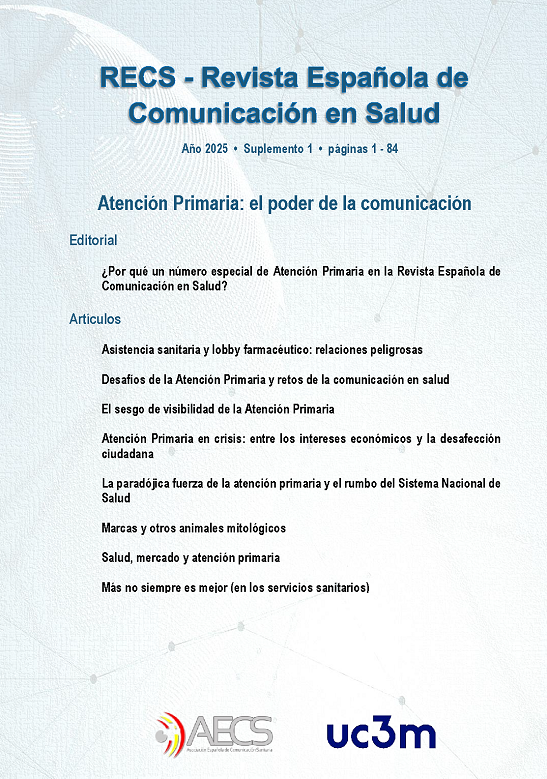
The paradoxical strength of primary healthcare and the course of the National Health System
DOI:
https://doi.org/10.20318/recs.2025.8794Keywords:
Primary Healthcare, communication, paradox, organization, competences, prestigeAbstract
Health systems based on strong primary care are superior because they achieve more health at lower cost and with equity. Primary care in Spain has generally good indicators, but young physicians shy away from family medicine in primary care and there is a dissociation between private and social values: what is socially necessary is not individually attractive to many professionals. In recent years there have been multiple plans and strategies, at international, state and regional levels, to “save” primary care, and an intense debate, tinged with interests, in which the labor demands of workers are sometimes identified with social welfare. The main idea of the organizational changes is that every minute of professional contributes value, and that each professional works at the limit of his or her competencies. Some clear and exemplary signals can be very effective, such as improving economic and working conditions in primary care, the greater presence of family medicine in universities and the encouragement of research in primary care. The generational renewal of family physicians and the potential of digitalization to consolidate networks where rural professionals do not feel isolated are reasons for optimism.
Downloads
References
Abellán Perpiñán, J. M., Sánchez Martínez, F. I., Martínez Pérez, J.-E., & Ruiz López, J. J. (2024). La atención primaria de salud en la Región de Murcia: Situación actual y propuestas de mejora. Consejo Económico y Social de la Región de Murcia.
Ballvé Moreno, J. L., Pujol Ribó, G., Eguinoa San Roman, B., Castella Cuesta, C., & Moreno Bella, J. L. (2010). La comunicación interna en atención primaria, una aproximación cualitativa. Atención Primaria, 42(3), 185-186. https://doi.org/10.1016/j.aprim.2009.05.011
Barber Perez, P., & Gonzalez Lopez-Valcarcel, B. G. (2022). Informe Oferta-Necesidad de Especialistas Médicos 2021-2035. Ministerio de Sanidad. https://www.sanidad.gob.es/areas/profesionesSanitarias/profesiones/necesidadEspecialistas/docs/2022Estudio_Oferta_Necesidad_Especialistas_Medicos_2021_2035V3.pdf
Beck RS, Daughtridge R. & Sloane PD. (2002). Physician-patient communication in the primary care office: A systematic review. The Journal of the American Board of Family Medicine, 15(1), 25-38.
Bjerrum L, Llor Vilà C. (2012). Dinamarca. AMF 8(8):519-521. Disponible en: https://amf-semfyc.com/es/web/articulo/dinamarca
Casajuana J, Gérvas Camacho JJ, Universitat Pompeu Fabra. La renovación de la atención primaria desde la consulta. Madrid: Springer Healthcare Ibérica; 2012. Disponible en: http://hdl.handle.net/10230/20284
Comisión Europea. (2018). A new drive for primary care in Europe: Rethinking the assessment tools and methodologies: Report of the expert group on health systems performance assessment. Publications Office. https://doi.org/doi/10.2875/58148
Esteve-Matalí, L., Vargas, I., Cots, F., Ramon, I., Sánchez, E., Escosa, A., & Vázquez, M. L. (2022). ¿La integración de la gestión de servicios sanitarios mejora la coordinación clínica? Experiencia en Cataluña. Gaceta Sanitaria, 36, 324-332. DOI: 10.1016/j.gaceta.2021.06.004
Federación de Sanidad y Sectores Sociosanitarios CCOO (FSS-CCOO). (2019). Plan Integral de Atención Primaria SNS. https://www.ccoo.es/7076864c59cf91de0011b51a7d15b19f000001.pdf
Fundación Ramón Areces e IVIE. (2021). Sistema de indicadores de accesibilidad a los servicios sanitarios. València, mayo de 2021. Base de datos disponible en: https://www.ivie.es/wp-content/uploads/2018/12/Indicadores_Accesibilidad_Servicios_Sanitarios_2019.xlsx
Gérvas, J. (2004). Atención Primaria de Salud en Europa: Tendencias a principios del siglo XXI. Una reflexión con motivo de los XXV años de la Declaración de Alma Ata. Semergen, 30(5), 245-257.
González López-Valcárcel, B., & Barber Pérez, P. (2024). La Medicina de Familia en el MIR. Wishful thinking y realismo constructivo. Revista Clínica de Medicina de Familia, 17(1), 5-8. https://doi.org/10.55783/rcmf.170101
Hernando Sarachaga, G., Izaguirre Olaizola, J., & Aguirre García, M. S. (2021). Integración del cuidado de la salud en Euskadi: Estudio cualitativo y diagnóstico del proceso de implementación de Osakidetza-Sistema Vasco de Salud. https://doi.org/10.5295/cdg.181030gh
Kripalani, S., LeFevre, F., Phillips, C. O., Williams, M. V., Basaviah, P., & Baker, D. W. (2007). Deficits in Communication and Information Transfer Between Hospital-Based and Primary Care Physicians: Implications for Patient Safety and Continuity of Care. JAMA, 297(8), 831-841. https://doi.org/10.1001/jama.297.8.831 61 //
Marshall, L., Charlesworth, A., & Hurst, J. (2014). The NHS payment system: Evolving policy and emerging evidence. London: The Nuffield Trust.
Ministerio de Sanidad (2022). Portal Estadístico. Área de Inteligencia de Gestión. Sistema de Información de Atención Primaria (SIAP). Profesionales de los Equipos de Atención Primaria (EAP). Disponible en: https://pestadistico.inteligenciadegestion.sanidad.gob.es/publicoSNS/C/sistema-de-informacion-de-atencion-primaria-siap/ profesionales/equipos-de-atencion-primaria-eap
Ministerio de Sanidad (2021). Plan de Acción de Atención Primaria y Comunitaria 2022-23. https://www.sanidad.gob.es/areas/calidadAsistencial/estrategias/atencionPrimaria/docs/Plan_de_Accion_de_Atencion_Primaria.pdf
https://www.sanidad.gob.es/organizacion/consejoInterterri/docs/1434.pdf
Ministerio de Sanidad (2019). Marco Estratégico para la Atención Primaria y Comunitaria. https://www.sanidad.gob.es/areas/calidadAsistencial/estrategias/atencionPrimaria/docs/Marco_Estrategico_APS_25Abril_2019.pdf
Ministerio de Sanidad y Consumo. (2007). Marco Estratégico para la mejora de la Atención Primaria en España: 2007-2012. Proyecto AP-21. https://www.sanidad.gob.es/en/profesionales/proyectosActividades/docs/AP21MarcoEstrategico2007_2012.pdf
Ministerio de Sanidad (2022). Indicadores clave. Sistema Nacional de Salud. https://inclasns.sanidad.gob.es/main.html OECD. (2023). Health at a Glance 2023. https://www.oecd-ilibrary.org/content/publication/7a7afb35-en
Pérez, M. (1989, octubre 28). La silla del doctor Marañón. El País. Disponible en: https://elpais.com/diario/1989/10/28/sociedad/625532403_850215.html
Porter, M. E. (2010). What Is Value in Health Care? New England Journal of Medicine, 363(26), 2477-2481. https:// doi.org/10.1056/NEJMp1011024
Sandvik, H., Hetlevik, Ø., Blinkenberg, J., & Hunskaar, S. (2022). Continuity in general practice as predictor of mortality, acute hospitalisation, and use of out-of-hours care: A registry-based observational study in Norway. British Journal of General Practice, 72(715), e84-e90. https://doi.org/10.3399/BJGP.2021.0340
Starfield, B., Shi, L., & Macinko, J. (2005). Contribution of Primary Care to Health Systems and Health. The Milbank Quarterly, 83(3), 457-502. https://doi.org/10.1111/j.1468-0009.2005.00409.x
Downloads
Published
-
Abstract1233
-
PDF 557
Issue
Section
License
All articles published in this journal –unless otherwise stated- are distributed under the terms of the Creative Commons Attribution-NoDerives (CC-BY-ND 3.0 ES) Spain 3.0 License, which allows others to copy, distribute and transmit in a public way as long as they credit the author(s), journal and institution that publish these articles, and provided that they are not altered or modified. The complete license can be consulted in: https://creativecommons.org/licenses/by/3.0/es/deed/.es
The copyright belongs to the manuscript’s author just on the basis of creating this work:
- Moral rights are undeniable and inalienable.
- Economic or exploitation rights can be transferred to third parties, as it occurs when articles are published and authors partially or totally transfer their exploitation rights to publishers
Authors can archive their own articles in an institutional repository as long as their publications are cited in this journal.