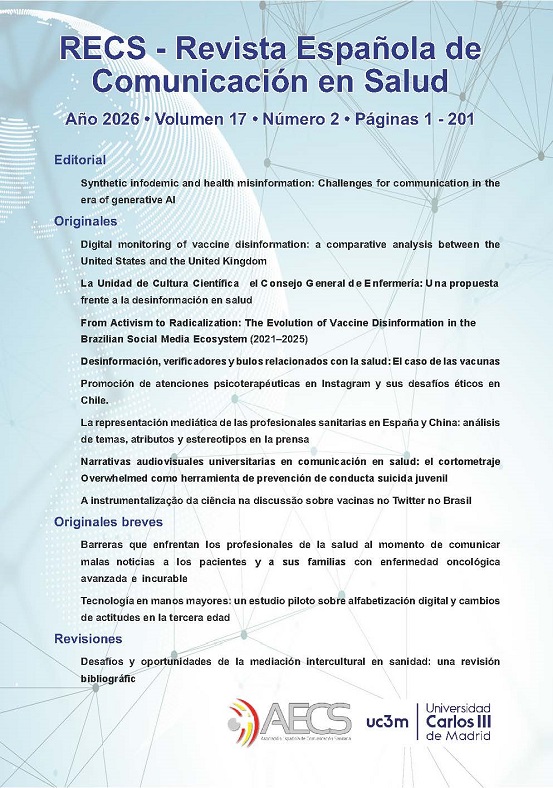
Barriers faced by Healthcare Professionals when communicating bad news to patients and their families with advanced and incurable cancer
DOI:
https://doi.org/10.20318/recs.2026.9683Keywords:
health communication, palliative care, cancerAbstract
Introduction: Breaking bad news in advanced oncology represents a significant clinical challenge. Objective: To identify the barriers perceived by medical specialists when communicating bad news in the context of advanced and incurable oncological diseases. Methods: This was a qualitative study with a descriptive-interpretative design. Semi-structured interviews were conducted with specialists in oncology and palliative care in Bogotá, Cali, and Medellín. Data analysis was performed using thematic analysis. Results: Four central themes were identified: (1) Cognitive barriers, related to insufficient training in communication skills and psychological first aid, as well as the absence of structured protocols; (2) Emotional barriers, characterized by tensions between autonomy and non-maleficence, and the need for empathy in emotional management; (3) Sociocultural barriers, associated with patients’ beliefs and educational levels, which influence disease understanding; and (4) Methodological/procedural barriers, linked to time and space constraints and family dynamics. Conclusions: Breaking bad news is a complex and contextual process that transcends the mere transmission of information. These findings highlight the need for educational strategies, early psychological support, and organizational adjustments that foster ethical, patient-centered clinical communication.
Downloads
References
Barbero, J. (2006). El derecho del paciente a la información: El arte de comunicar. Anales del Sistema Sanitario de Navarra, 29(Supl. 3), 19–27. http://scielo.isciii.es/scielo.php?script=sci_arttext&pid=S1137-66272006000600003
Bascuñán, M. L. (2005). Cambios en la relación médico-paciente y nivel de satisfacción de los médicos. Revista Médica de Chile, 133(1), 11–16. https://doi.org/10.4067/S0034-98872005000100002
Bascuñán, M. L., & Arriagada, A. M. (2016). Comunicación de errores médicos a pacientes y familiares: Interrogantes y herramientas. Revista Médica de Chile, 144(9), 1185–1190. https://doi.org/10.4067/S0034-98872016000900013
Botti, S., Conte, L., Cioce, M., Orlando, L., Tamagnini, E., Cannici, C., Capuano, A., De Cecco, V., Panzanaro, L., Serra, N., De Nunzio, G., Lupo, R., & Vitale, E. (2026). Healthcare professionals describe difficulties encountered when breaking bad news to oncology patients: An Italian observational study. Nursing Reports, 16(1), 38–51. https://doi.org/10.3390/nursrep16010004
Brito Guerrero, N. del R., Zurita Soria, M. M., Padrón Fernández, L., & Pérez Reyes, J. E. (2024). Comunicación asertiva de malas noticias a pacientes y familiares de cuidados paliativos. Qualitas Revista Científica, 28(28), 121–150. https://doi.org/10.55867/qual28.08
Costantini, A., Baile, W. F., Lenzi, R., Costantini, M., Ziparo, V., Marchetti, P., & Grassi, L. (2009). Overcoming cultural barriers to giving bad news: Feasibility of training to promote truth-telling to cancer patients. Journal of Cancer Education, 24(3), 180–185. https://doi.org/10.1080/08858190902876262
Daniella, H. H., Silvia, G., Isabel, H., & Mala, M. (2025). The information and communication needs of patients with advanced incurable cancer: A rapid review. Patient Education and Counseling, 131, Artículo 108559. https://doi.org/10.1016/j.pec.2024.108559
De los Ángeles Ruiz-Benítez de Lugo, M., & Coca, M. C. (2008). La conspiración del silencio en las familias del paciente oncológico terminal. Medicina Paliativa, 15(2), 104–109. https://doaj.org/article/8db3951ccc43443eb6a01f90a31944fe
Herrera, A., Ríos, M., Manríquez, J. M., & Rojas, G. (2014). Entrega de malas noticias en la práctica clínica. Revista Médica de Chile, 142(10), 1306–1315. https://doi.org/10.4067/S0034-98872014001000011
José, J., & Rodríguez, S. (2010). Comunicación clínica: Cómo dar malas noticias. Revista Médica Clínica Las Condes, 21(3), 478–482. https://doi.org/10.1016/S0716-8640(10)70561-1
Magnani, J. W., Mujahid, M. S., Aronow, H. D., Cené, C. W., Dickson, V. V., Havranek, E., Morgenstern, L. B., Paasche-Orlow, M. K., Pollak, A., & Willey, J. Z. (2018). Health literacy and cardiovascular disease: Fundamental relevance to primary and secondary prevention: A scientific statement from the American Heart Association. Circulation, 138(2), e48–e74. https://doi.org/10.1161/CIR.0000000000000579
Miller, E. M., Porter, J. E., & Barbagallo, M. S. (2022). The experiences of health professionals, patients, and families with truth disclosure when breaking bad news in palliative care: A qualitative meta-synthesis. Palliative and Supportive Care, 20(3), 433–444. https://doi.org/10.1017/S1478951521001243
Molina, J. M. G. (2020). Comunicación de malas noticias en el ámbito prehospitalario. Revista Española de Comunicación en Salud, 11(1), 121–125. https://doi.org/10.20318/recs.2020.4791
Murugesu, L., Heijmans, M., Rademakers, J., & Fransen, M. P. (2022). Challenges and solutions in communication with patients with low health literacy: Perspectives of healthcare providers. PLOS ONE, 17(5), e0267782. https://doi.org/10.1371/journal.pone.0267782
Prieto-Agüero, O. (2016). Comunicación sanitaria del profesional enfermero en mujeres con cáncer de mama. Revista Española de Comunicación en Salud, 7(1), 108–117. https://doi.org/10.20318/recs.2016.3159
Rosen, S., & Tesser, A. (1970). On reluctance to communicate undesirable information: The MUM effect. Sociometry, 33(3), 253–263. https://doi.org/10.2307/2786387
Sánchez, P. T., Sirera, R., Sánchez, J. M., & Camps, C. (2012). Comunicación y psicobioquímica. Cuadernos Monográficos de Psicobioquímica, 1, 13–23.
Welch, T. J., & Harrison, S. L. (2016). Teaching medicine through the study of literature: Implementing a fourth-year distance learning elective. Academic Medicine, 91(3), 360–364. https://doi.org/10.1097/ACM.0000000000001030
Downloads
Published
-
Abstract127
-
PDF 68
Issue
Section
License
Copyright (c) 2026 Tatiana Isabel Aya Porto, Nathalia Andrea Muñoz Montenegro, Stephanie Oliveros Sabalza

This work is licensed under a Creative Commons Attribution-NoDerivatives 3.0 Unported License.
All articles published in this journal –unless otherwise stated- are distributed under the terms of the Creative Commons Attribution-NoDerives (CC-BY-ND 3.0 ES) Spain 3.0 License, which allows others to copy, distribute and transmit in a public way as long as they credit the author(s), journal and institution that publish these articles, and provided that they are not altered or modified. The complete license can be consulted in: https://creativecommons.org/licenses/by/3.0/es/deed/.es
The copyright belongs to the manuscript’s author just on the basis of creating this work:
- Moral rights are undeniable and inalienable.
- Economic or exploitation rights can be transferred to third parties, as it occurs when articles are published and authors partially or totally transfer their exploitation rights to publishers
Authors can archive their own articles in an institutional repository as long as their publications are cited in this journal.