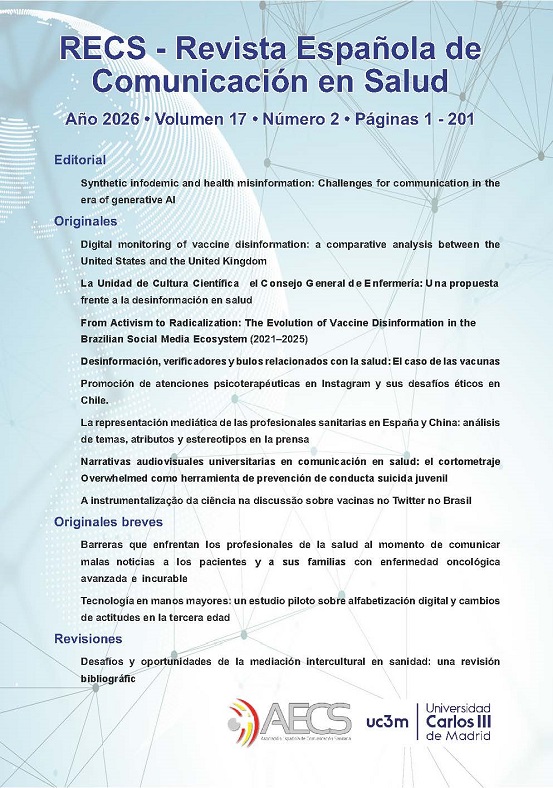
Promotion of psychotherapeutic services on Instagram and their Ethical in Chile
DOI:
https://doi.org/10.20318/recs.2026.9697Keywords:
mental health, psychotherapy, social media, influencers, health consumption, Chile, misinformationAbstract
Introduction: Mental health has become a central issue in Chile, within a context of high demand and unequal access to care. In this scenario, Instagram has gained a relevant role in promoting psychotherapeutic services, generating new forms of communication between professionals and potential users. Objectives: This qualitative study analyzes the meanings that psychotherapists attribute to this type of advertising and the associated ethical challenges. Method: An online focus group was conducted with eight recently graduated professionals, complemented by photo-elicitation using psychotherapy advertisements from Instagram. An inductive content analysis was applied. Results: Three main dimensions were identified: psychotherapy as a consumer good, marked by tensions between price and quality; the mediatization of practice, associated with the emergence of the “therapist influencer”; and proposals to address ethical challenges. Conclusion: These practices reflect tensions between market logics and ethics, implying communicative risks, but also opening opportunities to strengthen transparent training in mental health delivered through social media.
Downloads
References
Aceituno, R. (22 de mayo de 2017). La salud mental en Chile y la acreditación de psicólogos/as clínicos. Universidad de Chile. https://uchile.cl/noticias/133422/la-salud-mental-en-chile-y-la-acreditacion-de-psicologosas-clinicos
Aguilera, P., & Maluenda, F. (2020). Current situation and challenges for emergency medicine in Chile. European Journal of Emergency Medicine, 27(5), 323-324. https://doi.org/10.1097/MEJ.0000000000000750
Amanquez, D. E., & Perchik, N. Y. (2021). La utilización de Instagram como herramienta de marketing digital en las pymes. [Tesis de Grado, Universidad Nacional de San Martin]. Repositorio Institucional de la UNSAM. https://ri.unsam.edu.ar/handle/123456789/1579
American Psychological Association (2021). Guidelines for the Optimal Use of Social Media in Professional Psychological Practice: (507672021-001). https://doi.org/10.1037/e507672021-001
Bardin, L. (1991). Análisis de contenido. Ediciones AKAL.
Bernart, R., & Dobrowolski, C. (1998). La supervisión clínica en la formación. Redes: revista de psicoterapia relacional e intervenciones sociales, 2(4). 31-52.
Busta, C. (2017). La medicalización del malestar como proceso generador de desigualdad en el sistema de salud chileno / The medicalization of malaise as a generator of inequality in the Chilean health system. Castalia - Revista de Psicología de la Academia, 28(4), 19. https://doi.org/10.25074/07198051.4.591
Cabanas, E., & Illouz, E. (2021). Happycracia: Cómo la ciencia y la industria de la felicidad controlan nuestras vidas (1a ed., 8a reimp). Paidós.
Caicedo, B., & Berbesi, D. (2015). Salud autorreferida: Influencia de la pobreza y la desigualdad del área de residencia. Gaceta Sanitaria, 29(2), 97-104. https://doi.org/10.1016/j.gaceta.2014.11.007
Canales, M. (Ed.). (2006). Metodologías de investigación social: Introducción a los oficios (1a. ed). LOM Ediciones.
Charmaz, K. (2014). Constructing Grounded Theory. Sage. London.
Cinelli, M., Morales, G. D. F., Galeazzi, A., Quattrociocchi, W., & Starnini, M. (2020). Echo Chambers on Social Media: A comparative analysis. arXiv. https://doi.org/10.48550/arXiv.2004.09603
Conrad, P., & Leiter, V. (2004). Medicalization, Markets and Consumers. Journal of Health and Social Behavior, 45, 158-176.
Corella, J. M. (1998). Introducción a la gestión de marketing en los servicios de salud. Gobierno de Navarra, Departamento de Salud.
Corredor-Álvarez, F., & Íñiguez-Rueda, L. (2016). La foto-provocación como método. Su aplicación en un estudio de la autonomía en personas con diagnóstico de Trastorno Mental Severo. Empiria. Revista de metodología de ciencias sociales, 0(35). https://doi.org/10.5944/empiria.35.2016.17173
Correia, S. M., & Miranda, F. J. (2010). Calidad y satisfacción en el servicio de urgencias hospitalarias: análisis de un hospital de la zona centro de Portugal. Investigaciones Europeas de Dirección y Economía de la Empresa, 16(2), 27-41. https://doi.org/10.1016/S1135-2523(12)60110-5
De La Guardia, M. A., & Ruvalcaba, J. C. (2020). La salud y sus determinantes, promoción de la salud y educación sanitaria. Journal of Negative and No Positive Results, 5(1), 81-90. https://doi.org/10.19230/jonnpr.3215
Eizagaechevarria, N. M. (2016). E-ciudadanos, e-salud y redes sociales. Organizarse y formarse en alimentación y salud = e-citizens, e-health and social networks. How to organize and learn about food and health. Revista Española de Comunicación en Salud, 139-144.
Encina, E. (2020). Formación y participación comunitaria para los desafíos de salud mental: Escuela de Agentes Comunitarios en Salud Mental en Chile. En Experiencias Innovadoras en Extensión y Vinculación con el Medio. (Vicerrectoría de Extensión y Vinculación con el Medio. Universidad de Chile.).
Fernández, J. R., & Pérez, M. (2001). Separando el grano de la paja en los tratamientos psicológicos. Psicothema, 13(3), 337-344.
Foulkes, L., & Andrews, J. L. (2023). Are mental health awareness efforts contributing to the rise in reported mental health problems? A call to test the prevalence inflation hypothesis. New Ideas in Psychology, 69, 101010. https://doi.org/10.1016/j.newideapsych.2023.101010
Fuentes, A. (2010). ¿Cómo el Ingreso Afecta la Salud?: La Perspectiva de la Epidemiología Social. Ciencia & Trabajo, 35, 272-275.
Gómez, M., & García-Perdomo, H. A. (2023). Una aproximación práctica al marketing digital en salud: . Gaceta Médica Boliviana, 46(2), 103–107. https://doi.org/10.47993/gmb.v46i2.649
Guerrero, M., & Terrón, J. L. (2017). El influencer marketing en la red social Instagram: La nueva forma de publicitarse [Grau en Periodisme]. Universitat Autónoma de Barcelona. https://ddd.uab.cat/record/180477
Harper, D. (1986). Meaning and Work: A Study in Photo Elicitation. Current Sociology, 34(3), 24-46. https://doi.org/10.1177/001139286034003006
Illouz, E. (2010). La salvación del alma moderna: terapia, emociones y la cultura de la autoayuda. Katz Editores. ISBN: 9788492946013
IPSOS. (2022, octubre 10). Día Mundial de la Salud Mental 2022 | Ipsos. https://www.ipsos.com/es-pe/dia-mundial-de-la-salud-mental-2022
IPSOS. (2023, octubre 10). Dos de cada tres personas indican a la salud mental como principal problema de salud en Chile | Ipsos. https://www.ipsos.com/es-cl/dos-de-cada-tres-personas-indican-la-salud-mental-como-principal-problema-de-salud-en-chile
IPSOS. (2024, septiembre 25). La salud mental se considera como el principal problema de salud a nivel mundial y Chile lidera el ranking con un 69% | Ipsos. https://www.ipsos.com/es-cl/la-salud-mental-se-considera-como-el-principal-problema-de-salud-nivel-mundial-y-chile-lidera-el
Jiménez-Marín, G., Bellido-Pérez, E., & Trujillo Sánchez, M. (2021). Publicidad en Instagram y riesgos para la salud pública: El influencer como prescriptor de medicamentos, a propósito de un caso. Revista Española de Comunicación en Salud, 12(1), 43. https://doi.org/10.20318/recs.2021.5809
Keemink, J. R., Sharp, R. J., Dargan, A. K., & Forder, J. E. (2022). Reflections on the Use of Synchronous Online Focus Groups in Social Care Research. International Journal of Qualitative Methods, 21, 16094069221095314. https://doi.org/10.1177/16094069221095314
Kwon, O., & Wen, Y. (2010). An empirical study of the factors affecting social network service use. Computers in Human Behavior, 26(2), 254–263. https://doi.org/10.1016/j.chb.2009.04.011
Lal S, Adair CE. (2014). E-mental health: a rapid review of the literature. Psychiatr Serv.; 65(1):24-32. doi: 10.1176/appi.ps.201300009. PMID: 24081188.
Lambert, M. J. (2010). Prevention of treatment failure: The use of measuring, monitoring, and feedback in clinical practice. American Psychological Association. https://doi.org/10.1037/12141-000
Lampert, M. P. (2024). Plan Nacional de Salud Mental 2017–2025: Oferta programática. Biblioteca del Congreso Nacional de Chile
Latimer, T., Roscamp, J., & Papanikitas, A. (2017). Patient-centredness and consumerism in healthcare: An ideological mess. Journal of the Royal Society of Medicine, 110(11), 425-427. https://doi.org/10.1177/0141076817731905
Livingstone, S. (2004). Media Literacy and the Challenge of New Information and Communication Technologies. The Communication Review, 7(1), 3–14. https://doi.org/10.1080/10714420490280152
Llerena-Companioni, O. (2018). Aproximaciones a la profesionalización del psicólogo de la salud.// Approaches to the professionalization of the health psychologist. CIENCIA UNEMI, 11(28), 18-32. https://doi.org/10.29076/issn.2528-7737vol11iss28.2018pp18-32p
Manresa, C., Padrón, M. del, & Dorrego, M. V. (2019). Red social Instagram como herramienta de mercadeo en odontología. Implicaciones bioéticas. https://api.semanticscholar.org/CorpusID:213837836
Martínez-Felix, S., Ferrer-Yeves, C., & Martínez-Martínez, C. (2020). Aislamiento social y autoestima en personas con trastorno mental: Efecto de las actividades ocupacionales. Revista Española de Enfermería de Salud Mental, 12, Article 12. https://www.reesme.com/index.php/REESM-AEESME/article/view/98
Minoletti, A., Rojas, G., & Horvitz-Lennon, M. (2012). Salud mental en atención primaria en Chile: Aprendizajes para Latinoamérica. Cadernos Saúde Coletiva, 20(4), 440-447. https://doi.org/10.1590/S1414-462X2012000400006
Minuchin, S. (with Fichman, V.). (2004). Familias y terapia familiar. Gedisa.
OECD (2023), Health at a Glance 2023: OECD Indicators, OECD Publishing, Paris, https://doi.org/10.1787/7a7afb35-en.
Organización Mundial de la Salud (2023). World mental health report: transforming mental health for all. WHO. ISBN 978-92-4-004933-8
Pariser, E. (2011). The filter bubble. The Penguin Press. New York.
Porta, L., & Silva, M. (2003). La investigación cualitativa: El análisis de contenido en la investigación educativa. Anuario Digital de Investigación Educativa, 14, 388-406.
Priego, H. (2006). Consumo en salud análisis mercadológico del comportamiento del consumidor sanitario. Universitat Autònoma de Barcelona.
Rayón, L., Romera, M.,de las Heras, A., Torrego, A., & Bautista. A. (2021). Foto-Elicitación e indagación narrativa visual en estudio de casos y grupos de discusión. New Trends in Qualitative Research, 5, 41–56. https://doi.org/10.36367/ntqr.5.2021.41-56
Rodríguez-Echeverría, M. A., & Páez-Castro, A. M. (2018). Access barriers to visual health. Ciencia & Tecnología para la Salud Visual y Ocular, 16(1), 95-109. https://doi.org/10.19052/sv.5057
Rodríguez-Marín, J. (1998). Psicología de la salud y psicología clínica. Papeles del Psicólogo, 69. https://www.papelesdelpsicologo.es/resumen?pii=772
Saforcada, E., Sarriera, J. C., & Alfaro I., J. (Eds.). (2015). Salud comunitaria desde la perspectiva de sus protagonistas: La comunidad. Ediciones Nuevos Tiempos.
Stiglitz, J. E. (2000). La economía del sector público (3. ed). Bosch.
Tajan, N., Devès, M., & Potier, R. (2023). Tele-psychotherapy during the COVID-19 pandemic: A mini-review. Frontiers in Psychiatry, 14, 1060961. https://doi.org/10.3389/fpsyt.2023.1060961
Talavera-Valverde, M. A. (2018). La confianza personal clave en el desempeño ocupacional y la promoción de la salud. Revista electrónica de terapia ocupacional Galicia, TOG, 15(28). 191-193. https://www.revistatog.com/num28/pdfs/editorial1.pdf
Vicente, B., Saldivia, S., & Pihán, R. (2016). Prevalencias y brechas hoy: Salud mental mañana. Acta Bioethica, 22(1), 51-61. https://doi.org/10.4067/S1726-569X2016000100006
Vicente P, B., Kohn, R., Saldivia B, S., & Rioseco S, P. (2007). Carga del enfermar psíquico, barreras y brechas en la atención de Salud Mental en Chile. Revista Médica de Chile, 135(12). https://doi.org/10.4067/S0034-98872007001200014
Wang, P. S., Aguilar-Gaxiola, S., Alonso, J., Angermeyer, M. C., Borges, G., Bromet, E. J., Bruffaerts, R., De Girolamo, G., De Graaf, R., Gureje, O., Haro, J. M., Karam, E. G., Kessler, R. C., Kovess, V., Lane, M. C., Lee, S., Levinson, D., Ono, Y., Petukhova, M., … Wells, J. E. (2007). Use of mental health services for anxiety, mood, and substance disorders in 17 countries in the WHO world mental health surveys. The Lancet, 370(9590), 841-850. https://doi.org/10.1016/S0140-6736(07)61414-7
Zhang, L., Liu, D., Li, J., Wan, C., & Liu, X. (2024). Exploring linguistic features and user engagement in Chinese online mental health counseling. Heliyon, 10(19), e38042. https://doi.org/10.1016/j.heliyon.2024.e38042
Zuboff, S. (2019). The Age of Surveillance Capitalism: The Fight for a Human Future at the New Frontier of Power. PublicAffairs. New York.
Downloads
Published
-
Abstract209
-
PDF 95
Issue
Section
License
Copyright (c) 2026 Hans Max Klener Hernández, Cristóbal Miranda-Olivares, Thiare Barrera Miranda, Adriana Espinoza Soto

This work is licensed under a Creative Commons Attribution-NoDerivatives 3.0 Unported License.
All articles published in this journal –unless otherwise stated- are distributed under the terms of the Creative Commons Attribution-NoDerives (CC-BY-ND 3.0 ES) Spain 3.0 License, which allows others to copy, distribute and transmit in a public way as long as they credit the author(s), journal and institution that publish these articles, and provided that they are not altered or modified. The complete license can be consulted in: https://creativecommons.org/licenses/by/3.0/es/deed/.es
The copyright belongs to the manuscript’s author just on the basis of creating this work:
- Moral rights are undeniable and inalienable.
- Economic or exploitation rights can be transferred to third parties, as it occurs when articles are published and authors partially or totally transfer their exploitation rights to publishers
Authors can archive their own articles in an institutional repository as long as their publications are cited in this journal.