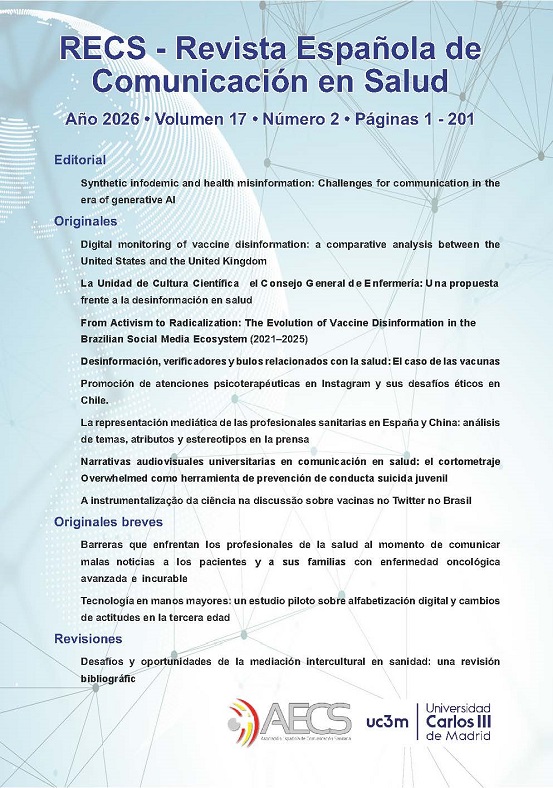
University audiovisual narratives in health communication
The short film Overwhelmed as a vehicle for preventing youth suicidal behavior
DOI:
https://doi.org/10.20318/recs.2026.9711Keywords:
mental health, prevention of suicidal behaviour, health communication, young people, awarenessAbstract
Introduction: Mental health and suicidal behaviour in young people represent a growing challenge that requires effective and sensitive prevention strategies. Audiovisual resources offer significant capability for enhancing awareness and facilitating education in this domain. Objectives: The present study will analyse the university short film Overwhelmed as a health communication tool aimed at preventing suicidal behaviour in young people, evaluating its ability to raise awareness, destigmatise and promote socio-communicative action. Methodology: The present study adopts a research design, the case study, which uses fundamentally qualitative methods, oriented to systematically document and analyse the communicative and formative process of the short film Overwhelmed, with the purpose of evaluating its potential as a tool for raising awareness in mental health and as a replicable model of university-community collaboration. Results: A transdisciplinary collaboration, a sensitive narrative, and a screening of the short film in a high-visibility cultural context reinforced its legitimacy as an educational resource, hereby facilitating the understanding of the messages, identification with the protagonists, and reflection on mental health. Conclusion: University short films have been identified as an effective health communication strategy, combining emotional impact, ethical rigour, and educational relevance, especially when designed through collaborative processes with a focus on prevention.
Downloads
References
Ahad, A. A., Sanchez Gonzalez, M., & Junquera, P. (2023). Understanding and addressing mental health stigma across cultures for improving psychiatric care: A narrative review. Cureus, 15(5), e39549. https://doi.org/10.7759/cureus.39549
Aleksandra Lazareva, Gibran Cruz-Martinez, Digital Storytelling Project as a Way to Engage Students in Twenty-First Century Skills Learning (2021). International Studies Perspectives, Volume 22, Issue 4, November, pp. 383–406, https://doi.org/10.1093/isp/ekaa017
APCP (2025, 13 marzo). Eventérate: Málaga, ¡allá vamos!. https://apcp.es/eventerate-malaga-alla-vamos/
Arana Arrieta, E., Mimenza Castillo, L., & Narbaiza Amillategi, B. (2020). Pandemia, consumo audiovisual y tendencias de futuro en comunicación. Revista De Comunicación Y Salud, 10(2), 149–183. https://doi.org/10.35669/rcys.2020.10(2).149-183
Asociación Estadounidense de Psiquiatría (2013). Manual diagnóstico y estadístico de los trastornos mentales (5.ª ed.). https://doi.org/10.1176/appi.books.9780890425596
Ayuntamiento de Málaga (2025, 13 marzo). Publicación en Instagram sobre “Overwhelmed”. Instagram. https://www.instagram.com/p/DGx9wzvsxlG/?img_index=3&igsh=MW9zemdrNnBzMzBnaQ==
Bernhardt, J. M. (2004). Communication at the core of effective public health. American Journal of Public Health, 94(12), pp. 2051–2053. https://doi.org/10.2105/AJPH.94.12.2051
Bizzotto, N., de Bruijn, G.-J., & Schulz, P. J. (2023). Buffering against exposure to mental health misinformation in online communities on Facebook: The interplay of depression literacy and expert moderation. BMC Public Health, 23, 1577. https://doi.org/10.1186/s12889-023-16404-1
Braun, M., Till, B., Pirkis, J., & Niederkrotenthaler, T. (2023). Effects of suicide prevention videos developed by and targeting adolescents: a randomized controlled trial. Eur Child Adolesc Psychiatry 32, pp. 847–857. https://doi.org/10.1007/s00787-021-01911-6
Canal Málaga Televisión (2025, 20 marzo). Málaga aquí y ahora con Paula Sánchez Mercado [Archivo de vídeo]. bit.ly/423omyB
Canal Sur Más (2025, 28 marzo). Atrápame si puedes [Programa de televisión]. http://bit.ly/4mA0Bqa
Canal Sur Radio (2025, 20 marzo). Entrevista sobre el cortometraje Overwhelmed. http://www.canalsur.es/multimedia.html?id=2177111
Clement, S., Schauman, O., Graham, T., Maggioni, F., Evans-Lacko, S., Bezborodovs, N., Morgan, C., Rüsch, N., Brown, J. S. L., & Thornicroft, G. (2013). What is the impact of mental health-related stigma on help-seeking? A systematic review of quantitative and qualitative studies. Psychological Medicine, 45(1), pp. 11–27. https://doi.org/10.1017/S0033291714000129
Creswell, J. W., & Creswell, J. D. (2018). Research design: Qualitative, quantitative, and mixed methods approaches (5th ed.). Thousand Oaks, CA: Sage Publications.
Crowe, S., Cresswell, K., Robertson, A., Huby, G., Avery, A., & Sheikh, A. (2011). The case study approach. BMC Medical Research Methodology, 11, 100. https://doi.org/10.1186/1471-2288-11-100
Diario SUR (2025, 13 marzo). ‘Overwhelmed’, el corto protagonizado por alumnos de la UMA que aborda el duelo y la salud mental. https://lc.cx/-nh40h
Draganidis, A., Fernando, A. N., West, M. L., & Sharp, G. (2024). Social media delivered mental health campaigns and public service announcements: A systematic literature review of public engagement and help-seeking behaviours. Social Science & Medicine, 359, 117231. https://doi.org/10.1016/j.socscimed.2024.117231
Festival de Málaga (2025, 13 marzo). Publicación en Instagram sobre “Overwhelmed”. Instagram. https://www.instagram.com/p/DGx0udLibxX/?igsh=aXRwN3l0cGQ0YzEy
Festival de Málaga (2025, 20 marzo). Overwhelmed – Emotivo estreno del cortometraje en el 28 Festival de Cine de Málaga [Vídeo]. YouTube. https://youtu.be/wu2y1TmGbeU?si=_SFzZ-LjTIjQHCK3
Goodwin, J., Behan, L., Mohamad M. Saab; Niamh O’Brien; Aine O’Donovan; Andrew Hawkins; Lloyd F. Philpott; Alicia Connolly; Ryan Goulding; Fiona Clark; Deirdre O’Reilly; Corina Naughton (2024). A film-based intervention (Intinn) to enhance adolescent mental health literacy and well-being: Multi-methods evaluation study. Mental Health Review Journal, 29(1), pp. 48–63. https://doi.org/10.1108/MHRJ-05-2023-0027
Goodwin, J., Saab, M. M., Dillon, C. B., McCarthy, A., O’Brien, M., & Philpott, L. F. (2021). The use of film-based interventions in adolescent mental health education: A systematic review. Journal of Psychiatric Research, 137, pp. 158–172. doi:10.1016/j.jpsychires.2021.02.055
Goodyear, V. A., Armour, K. M., & Wood, H. (2018). Young people and their engagement with health-related social media: New perspectives. Sport, Education and Society, 24(7), pp. 673–688. https://doi.org/10.1080/13573322.2017.1423464
Instituto Nacional de Estadística (2024). Defunciones por causa de muerte. Año 2023. INE. https://www.ine.es/dyngs/Prensa/pEDCM2023.htm#:~:text=En%20el%20a%C3%B1o%202023%20se,que%20en%202022%2C%20respectivamente).
Kite, J., Chan, L., MacKay, K., Corbett, L., Reyes-Marcelino, G., Nguyen, B., Bellew, W., & Freeman, B. (2023). A Model of Social Media Effects in Public Health Communication Campaigns: Systematic Review. Journal of medical Internet research, 25, e46345. https://doi.org/10.2196/46345
Krajcik, J., & Blumenfeld, P. C. (2005). Project-based learning. En R. K. Sawyer (Ed.). The Cambridge handbook of the learning sciences. Cambridge University Press, pp. 317–334. doi: https://doi.org/10.1017/CBO9780511816833.020
La Opinión de Málaga (2025, 24 marzo). Un corto de alumnos de la UMA rompe tabús sobre la salud mental. https://www.laopiniondemalaga.es/malaga/2025/03/24/corto-overwhelmed-alumnos-uma-rompe-tabus-alheli-115558603.html
Liu, J., & Zhang, Y. (2024). Modeling health video consumption behaviors on social media platforms: An exploratory study. arXiv. Vol. 8, No. CSCW1, Article 208. https://arxiv.org/abs/2311.09040
Maxwell, J. A. (2013). Qualitative research design: An interactive approach (3rd ed.). Thousand Oaks, CA: Sage Publications.
Mezirow, J., & Taylor, E. W. (2023). Transformative learning in practice: Insights from community-based education. San Francisco: Jossey-Bass/Wiley.
Ministerio de sanidad (2020). Recomendaciones para el tratamiento del suicidio por los medios de comunicación. Manual de apoyo para sus profesionales.https://www.sanidad.gob.es/areas/calidadAsistencial/estrategias/saludMental/docs/MANUAL_APOYO_MMCC_SUICIDIO_03.pdf
Moreno Küstner, B. (2024). Experiencia investigadora en prevención del suicidio y desarrollo del primer Plan de Prevención de la Conducta Suicida en la Universidad de Málaga. Grupo de Prevención del Suicidio de Málaga. https://lanochedelosinvestigadores.fundaciondescubre.es/investigador/berta-moreno-kustner/
Naslund, J. A., Aschbrenner, K. A., Araya, R., Marsch, L. A., Unützer, J., Patel, V., & Bartels, S. J. (2020). Digital technology for treating and preventing mental disorders in low-income and middle-income countries: A narrative review of the literature. The Lancet Psychiatry, 7(6), 487–500. doi: 10.1016/S2215-0366(17)30096-2
Niederkrotenthaler, T., Voracek, M., Herberth, A., Till, B., Strauss, M., Etzersdorfer, E., Eisenwort, B., & Sonneck, G. (2010). Role of media reports in completed and prevented suicide: Werther v. Papageno effects. The British Journal of Psychiatry, 197(3), 234–243. https://doi.org/10.1192/bjp.bp.109.074633
Organización Mundial de la Salud (2023). Prevención del suicidio un instrumento para profesionales de los medios de comunicación. https://iris.paho.org/server/api/core/bitstreams/a762cf09-8591-4abe-9ef6-30b2211e6145/content
Patton, M. Q. (2015). Qualitative research & evaluation methods (4th ed.). Thousand Oaks, CA: Sage Publications.
Pérez Costillas, L. (2024). Estrategias comunicativas en prevención del suicidio: Reflexiones desde la praxis clínica y comunitaria. Grupo Andaluz de Prevención de Conductas Suicidas. https://commalaga.com/los-medios-de-comunicacion-tienen-un-papel-fundamental-en-la-prevencion-del-suicidio/
Prince, M. J., & Felder, R. M. (2007). The many faces of inductive teaching and learning. Journal of College Science Teaching, 36(5), 14–20. https://www.pfw.edu/offices/celt/pdfs/Inductive(JCST).pdf
Rimal, R. N., & Lapinski, M. K. (2009). Why health communication is important in public health. Bulletin of the World Health Organization, 87(4), 247. https://doi.org/10.2471/BLT.08.056713
Robinson, J., Hill, N. T., Thorn, P., Battersby, R., Teh, Z., Reavley, N. J., Pirkis, J., & Lamblin, M. (2017). Developing social media-based suicide prevention messages in partnership with young people: Exploratory study. JMIR Mental Health, 4(4), e40. https://doi.org/10.2196/mental.7847
Rutz, W., & Pirkis, J. (2017). Suicide prevention: A global perspective. Luxemburgo: Springer.
Schiavo, R. (2023). Health communication: From theory to practice (2nd ed.). San Francisco: Jossey-Bass.
Scottish Government (2020). Cinematherapy and film-based interventions for adolescent suicide prevention: A systematic review. Edinburgh: Scottish Government.
Sonke, J., Sams, K., Morgan-Daniel, J., & Pumariega, A. (2021). Systematic review of arts-based interventions to address suicide prevention and survivorship in Australia, Canada, the United Kingdom, and the United States of America. Health Promotion Practice, 22(1_suppl), 53S–63S. https://doi.org/10.1177/1524839921996350
Stake, R. E. (1995). The art of case study research. Thousand Oaks, CA: Sage.
Teatro Cervantes (2025, 13 marzo). Rueda de prensa del Espacio Solidario del 28 Festival de Málaga. https://prensa.teatrocervantes.com/FESTIVAL_Rueda_EspacioSolidario.zip
Thomas, J. W. (2000). A review of research on project-based learning. The Autodesk Foundation. http://www.bie.org/research/study/review_of_project_based_learning_2000
Tizón JL, Ciurana R, Fernández-Alonso MDC, Buitrago F. (2022). La salud mental de los jóvenes y la pandemia de la COVID-19: la parcialización y pixelación de la juventud. FMC. 2022 Apr;29(4):159-163. https://pmc.ncbi.nlm.nih.gov/articles/PMC9045741/
UNICEF & USAID (s.f.). Social and behavior change communication. UNICEF. Social+Behavior change. https://www.sbcguidance.org/understand/social-and-behaviour-change-communication
Universidad de Málaga (2025, 13 marzo). Estudiantes y docentes de la UMA ruedan un cortometraje solidario sobre el duelo y la salud mental. https://lc.cx/zyaWPg
World Health Organization (2023). Preventing suicide: A resource for media professionals. WHO. https://www.who.int/publications/i/item/9789240076846
Yardley, L., Morrison, L., Bradbury, K., & Muller, I. (2015). The person-based approach to intervention development: Application to digital health-related behavior change interventions. Journal of Medical Internet Research, 17(1), e30. https://doi.org/10.2196/jmir.4055
Yew, E. H. J., & Goh, K. (2016). Problem-based learning: An overview of its process and impact on learning. Health Professions Education, 2(2), pp. 75–79. https://doi.org/10.1016/j.hpe.2016.01.004
Yin, R. K. (2018). Case study research and applications: Design and methods (6th ed.). Thousand Oaks, CA: Sage.
Zeng, H., Yao, G., & Ma, X. (2025). The impact of short videos on young people’s willingness to learn: Mediating role of emotional arousal and flow experience. Humanities and Social Sciences Communications, 12, 624, pp. 1-17. https://doi.org/10.1057/s41599-025-04963-0
Downloads
Published
-
Abstract233
-
PDF 92
Issue
Section
License
Copyright (c) 2026 Penélope Martín Martín, Fernando Sánchez Gómez, Gema Lobillo Mora

This work is licensed under a Creative Commons Attribution-NoDerivatives 3.0 Unported License.
All articles published in this journal –unless otherwise stated- are distributed under the terms of the Creative Commons Attribution-NoDerives (CC-BY-ND 3.0 ES) Spain 3.0 License, which allows others to copy, distribute and transmit in a public way as long as they credit the author(s), journal and institution that publish these articles, and provided that they are not altered or modified. The complete license can be consulted in: https://creativecommons.org/licenses/by/3.0/es/deed/.es
The copyright belongs to the manuscript’s author just on the basis of creating this work:
- Moral rights are undeniable and inalienable.
- Economic or exploitation rights can be transferred to third parties, as it occurs when articles are published and authors partially or totally transfer their exploitation rights to publishers
Authors can archive their own articles in an institutional repository as long as their publications are cited in this journal.
How to Cite
Funding data
-
Ministerio de Ciencia e Innovación
Grant numbers PID2023-151727NB-I00