Design and validation of an Animated Character for Healthy Food Promotion in Mexican Schoolchildren
DOI:
https://doi.org/10.20318/recs.2026.9792Keywords:
food and nutricion education, cartoons, children, health education, food and nutritional health promotionAbstract
Introduction: The food environment in Mexico promotes the consumption of unhealthy foods, with advertising characters being a common resource used by the food industry to encourage the consumption of ultra-processed among children. However, their effectiveness suggests potential for repurposing them into educational tools to promote healthy eating habits. The objective of this study was to design and validate an animated character to promote healthy foods among schoolaged children. Methodology: A descriptive-analytical cross-sectional study with 70 children aged 6–12 years, carried out in two phases: 1) design and 2) validation of the animated character. Population validation was measured using a Likert scale (appearance) and a Stapel scale (attitudes and emotions), with a criterion of ≥4 considered acceptable. Informed consent was obtained from parents and assent from the children. Results: Acceptance of the character was positive (4.0, SD: 0.86; “I like it”). The highest-rated attributes were “Intelligent” (μ: 4.18, SD: 1.26), “Friendly” (μ: 4.14, SD: 1.37), “Fun” (μ: 4.09, SD: 1.18), and “Trustworthy” (μ: 4.06, SD: 1.21), with no differences across school grades. Conclusions: The animated character met the validation criteria, demonstrating favorable acceptance in appearance and positive attributes, confirming its potential use as an educational tool to promote healthy eating habits.
Downloads
References
Ares, G., Arrúa, A., Antúnez, L., Vidal, L., Machín, L., Martínez, J., Curutchet, M. R., & Giménez, A. (2016). Influence of label design on children’s perception of two snack foods: Comparison of rating and choice-based conjoint analysis. Food Quality and Preference, 53, 1–8. https://doi.org/10.1016/j.foodqual.2016.05.006
Barquera, S., Hernández-Barrera, L., Rothenberg, S. J., & Cifuentes, E. (2018). The obesogenic environment around elementary schools: food and beverage marketing to children in two Mexican cities. BMC Public Health, 18(461), 1-9. https://doi.org/10.1186/s12889-018-5374-0
Barreto, M. (2011). Consideraciones ético-metodológicas para la investigación en educación inicial. Revista Latinoamericana de Ciencias Sociales, Niñez y Juventud, 2, 635–648. https://www.redalyc.org/pdf/773/77321592011.pdf
Boyland, E. J., Nolan, S., Kelly, B., Tudur-Smith, C., Jones, A., Halford, J. C., & Robinson, E. (2016). Advertising as a cue to consume: a systematic review and meta-analysis of the effects of acute exposure to unhealthy food and nonalcoholic beverage advertising on intake in children and adults. The American Journal of Clinical Nutrition, 103(2), 519–533. https://doi.org/10.3945/ajcn.115.120022
Chávez, A. (2019). Inversión publicitaria en México. Revista Merca 2.0. https://www.merca20.com/infografia-inversion-publicitaria-en-mexico/
Cibrián, T., & Dueñas, B. (2016). Escalas de actitud para evaluar la personalidad de los personajes publicitarios/Attitude scales to assess the personality of the advertising. Revista Digital de Diseño Gráfico, 16. www.apps.buap.mx/ojs3/index.php/insigne/article/view/1357
Contreras-Manzano, A., Jáuregui, A., Vargas-Meza, J., Nieto, C., Granich-Armenta, Alemán Escobar, M. L., Olvera, A. G., Cruz-Casarrubias, C., Munguía, A., & Barquera, S. (2022). Objective understanding of front of pack warning labels among Mexican children of public elementary schools. A randomized experiment. Nutrition Journal, 21(47), 1-14. https://doi.org/10.1186/s12937-022-00791-z
Cruz-Casarrubias, C., Tolentino-Mayo, L., Nieto, C., Théodore, F. L., & Monterrubio-Flores, E. (2020). Use of advertising strategies to target children in sugar‐sweetened beverages packaging in Mexico and the nutritional quality of those beverages. Pediatric Obesity, 16(2), 1-10. https://doi.org/10.1111/ijpo.12710
Díaz-Beltrán M. (2014). Factores influyentes en el comportamiento alimentario infantil. Revista de la Facultad de Medicina, 62(2),237-245. https://doi.org/10.15446/revfacmed.v62n2.45414
De Droog, S. M., Valkenburg, P. M., & Buijzen, M. (2011). Using brand characters to promote young children’s liking of and purchase requests for fruit. Journal of Health Communication, 16(1), 79–89. https://doi.org/10.1080/10810730.2010.529487
De Droog, SM, Buijzen, M. & Valkenburg, PM (2012). ¿Usar un conejo o un rinoceronte para vender una zanahoria? El efecto de la congruencia entre carácter y producto en el gusto de los niños por los alimentos saludables. Journal of Health Communication,17(9), 1068–1080. https://doi.org/10.1080/10810730.2011.650833
Fondo de las Naciones Unidas para la Infancia [UNICEF]. (2019, octubre). Estado Mundial de la Infancia 2019. Niños, alimentos y nutrición: crecer bien en un mundo en transformación [Resumen Ejecutivo] https://www.unicef.org/es/informes/estado-mundial-de-la-infancia-2019
García Redondo, J., & Hita García, I. (2011). La influencia de la publicidad en la salud de la población infantil. Revista Española de Comunicación en Salud, 87–96. https://e-revistas.uc3m.es/index.php/RECS/es/article/view/3396
Garretson, J. & Burton, S. (2005). The Role of Spokescharacters as Advertisement and Package Cues in. The Journal of Advertising, 69. 118–132. https://journals.sagepub.com/doi/abs/10.1509/jmkg.2005.69.4.118
Garzillo, J., Schoenardie, V., Leite, F. M., Steele, E., Pereira, P., da Costa, M., Levy, R., & Monteiro, C. (2022). Ultra-processed food intake and diet carbon and water footprints: a national study in Brazil. Revista de Saude Publica, 56, 1–9. https://doi.org/10.11606/s1518-8787.2022056004551
Guzmán Ramírez, J. A. (2016). Una metodología para la creación de personajes desde el diseño de concepto. Iconofacto, 12(18), 96–117. https://doi.org/10.18566/v12n18.a06
Harris, J. L., Speers, S. E., Schwartz, M. B., & Brownell, K. D. (2012). US Food Company Branded Advergames on the Internet: Children’s exposure and effects on snack consumption. Journal of Children and Media, 6(1), 51–68. https://doi.org/10.1080/17482798.2011.633405
Institute of Medicine. (2006). Food marketing to children and youth: threat or opportunity? [Promoción de alimentos dirigida a niños y jóvenes: ¿amenaza u oportunidad?]. In National Academy of Sciences. https://doi.org/10.17226/11514
Instituto Nacional de Salud Pública & Fondo de las Naciones Unidas para la Infancia. (INSP, UNICEF, 2021). Publicidad y promoción de alimentos y bebidas dirigidas a niñas, niños y adolescentes en los puntos de venta en México. https://www.insp.mx/resources/images/stories/2022/docs/220104_Unicef_digital.pdf
Islas Vega, I., Reynoso Vázquez, J., Hernández Ceruelos, M. C. A., & Ruvalcaba Ledezma, J. C. (2020). La alimentación en México y la influencia de la publicidad ante la debilidad en el diseño de políticas públicas. Journal of Negative & No Positive Results, 5(8), 853–862. https://doi.org/10.19230/jonnpr.3259
Karpyn, A., Sawyer-Morris, G., Grajeda, S., Tilley, K., & Wolgast, H. (2020). Impact of Animal Characters at a Zoo Concession Stand on Healthy Food Sales. Journal of Nutrition Education and Behavior, 52(1), 80–86. https://doi.org/10.1016/j.jneb.2019.09.013
Keller, K., Kuilema, L., Lee, N., Yoon, J., Mascaro, B., & Combes, A. (2012). The impact of food branding on children’s eating behavior and obesity. Physiology and Behavior, 106(3), 379–386. https://doi.org/10.1016/j.physbeh.2012.03.011
Kelly, B., Halford, J. C. G., Boyland, E. J., Chapman, K., Bautista-Castaño, I., Berg, C., Caroli, M., Cook, B., Coutinho, J. C., Effertz, T., Grammatikaki, E., Keller, K., Leung, R., Manions, Y., Monteiro, R., Pedley, C., Prell, H., Raine, K., Recine, E., Serra-Majem, L., Singh, S., & Summerbell, C. (2010). Television food advertising to children: A global perspective. American Journal of Public Health, 100(9), 1730–1736. https://doi.org/10.2105/AJPH.2009.179267
Kipper, D. J. (2016). Ética en la investigación con niños y adolescentes. Revista de Bioética, 24(1), 37–48. http://dx.doi.org/10.1590/1983-80422016241104
Kotler, P. & Armstrong, G. (2012). Marketing (L.E. Pineda Ayala, Trad.; 14 ed.). Pearson Education. https://www.academia.edu/42228046/Kotler_P_and_Armstrong_G_2012_Marketing_14e_PEARSON_EDUCACI%C3%93N_M%C3%A9xico4
Kraak, V. I., & Story, M. (2015). Influence of food companies’ brand mascots and entertainment companies’ cartoon media characters on children’s diet and health: A systematic review and research needs. Obesity Reviews, 16(2), 107–126. https://doi.org/10.1111/obr.12237
Lapierre, M. A., Vaala, S. E., & Linebarger, D. L. (2011). Influence of licensed spokescharacters and health cues on children’s ratings of cereal taste. Archives of Pediatrics and Adolescent Medicine, 165(3), 229-234. https://doi.org/10.1001/archpediatrics.2010.300
Leonard, B., Campbell, M. C., & Manning, K. C. (2019). Kids, caregivers, and cartoons: The impact of licensed characters on food choices and consumption. Journal of Public Policy & Marketing, 38(2), 214–231. https://doi.org/10.1177/0743915619827919
Letona, P., Chacon, V., Roberto, C., & Barnoya, J. (2014). Effects of licensed characters on children’s taste and snack preferences in Guatemala, a low/middle income country. International Journal of Obesity, 38, 1466–1469. https://doi.org/10.1038/ijo.2014.38
López-Torres, L, & López-Alcaraz, F. (2022). Los productos ultra-procesados: Implicancias sobre su consumo, avances y retos en América Latina para la salud pública en adultos. Revista Chilena de Nutrición, 49(5), 637–643. http://dx.doi.org/10.4067/S0717-75182022000600637
Lowe, C. F., Horne, P. J., Tapper, K., Bowdery, M., & Egerton, C. (2004). Effects of a peer modelling and rewards-based intervention to increase fruit and vegetable consumption in children. European Journal of Clinical Nutrition, 58(3), 510–522. https://doi.org/10.1038/sj.ejcn.1601838
Martín Díaz, A., Aguilera Cervantes , V, Housni , F., Rangel Bernal, N., & Campos Uscanga, Y. (2025). Mercadotecnia de alimentos en México: Revisión sistemática sobre su impacto en la dieta infantil. RESPYN Revista Salud Pública y Nutrición, 24(1), 30–40. https://doi.org/10.29105/respyn24.1-840
McGale, L. S., Grovenor Halford, J. C., Harrold, J. A., & Boyland, E. J. (2016). The influence of brand equity characters on children’s food preferences and choices. The Journal of Pediatrics, 177, 33–38. https://doi.org/10.1016/j.jpeds.2016.06.025
Munguía-Serrano, A., Tolentino-Mayo, L., Théodore, F. L., & Vandevijvere, S. (2020). Nutritional quality of hidden food and beverage advertising directed to children: Extent and nature of product placement in Mexican television programs. International Journal of Environmental Research and Public Health, 17(9), 1-11. https://doi.org/10.3390/ijerph17093086
Organización Mundial de la Salud. (2010). Conjunto de recomendaciones sobre la promoción de alimentos y bebidas no alcohólicas dirigida a los niños. https://www.who.int/es/publications/i/item/9789241500210
Organización Panamericana de la Salud. (2011). Recomendaciones de la Consulta de Expertos de la Organización Panamericana de la Salud sobre la promoción y publicidad de alimentos y bebidas no alcohólicas dirigida a los niños en la Región de las Américas. https://www.paho.org/hq/dmdocuments/2012/Experts-Food-Marketing-to-Children-(SPA).pdf
Ortiz-Pérez, H., Molina-Frechero, N., Martínez-Barbabosa, I., & Córdova-Moreno, R. (2015). Contenido nutricional de los alimentos promovidos por el Canal 5 de la televisión mexicana dirigidos a la población infantil. Revista Chilena de Nutrición, 42(3), 260–266. https://doi.org/10.4067/s0717-75182015000300006
Oviedo-Solís, C. I., Monterrubio-Flores, E. A., Cediel, G., Denova-Gutiérrez, E., & Barquera, S. (2022). Trend of ultraprocessed product intake is associated with the double burden of malnutrition in Mexican children and adolescents. Nutrients, 14(20), 1-13. https://doi.org/10.3390/nu14204347
Pempek, T. A., & Calvert, S. L. (2009). Tipping the balance: use of advergames to promote consumption of nutritious foods and beverages by low-income African American children: Use of advergames to promote consumption of nutritious foods and beverages by low-income African American children. Archives of Pediatrics & Adolescent Medicine, 163(7), 633–637. https://doi.org/10.1001/archpediatrics.2009.71
Phillips, B. J. (1996). Defining trade characters and their role in American popular culture. Journal of Popular Culture, 29(4), 143–158. https://doi.org/10.1111/j.0022-3840.1996.1438797.x
Popkin, B. (2020). El impacto de los alimentos ultraprocesados en la salud (2030/ Alimentación, agricultura y desarrollo rural en América Latina y el Caribe, Documento No. 34). Organización de las Naciones Unidas para la Alimentación y la Agricultura (FAO), Santiago de Chile. https://openknowledge.fao.org/server/api/core/bitstreams/c363cb5d-a2d2-40ea-abf3-1c10988bd540/content
Reymundo, A., & Rangel, N. (2025). Factores psicológicos en la intervención interdisciplinar del sobrepeso y la obesidad: El MPSB, los estilos interactivos y las competencias. En Extensiones y aplicaciones de una teoría de campo en la psicología (pp. 127–144). Universidad de Guadalajara.
Reyes, M, García J., & Tellez Castilla, M. (2018). Impacto de la publicidad en los hábitos alimenticios en los niños. Revista Española de Comunicación en Salud, 9(2), 116. https://doi.org/10.20318/recs.2018.4490
Rincón-Gallardo Patiño, S., Tolentino-Mayo, L., Flores Monterrubio, E. A., Harris, J. L., Vandevijvere, S., Rivera, J. A., & Barquera, S. (2016). Nutritional quality of foods and non-alcoholic beverages advertised on Mexican television according to three nutrient profile models. BMC Public Health, 16, 1-11. https://doi.org/10.1186/s12889-016-3298-0
Shamah-Levy, T., Ruiz-Matus, C., Rivera-Dommarco, J., Kuri-Morales, P., Cuevas-Nasu, L., Jiménez-Corona, M. E., Romero-Martínez, M., Méndez Gómez-Humarán, I., Gaona-Pineda, E. B., Gómez-Acosta, L. M., & Hernández-Ávila, M. (2017). Encuesta Nacional de Salud y Nutrición de Medio Camino 2016: Resultados nacionales. Instituto Nacional de Salud Pública (MX). https://www.insp.mx/images/stories/2017/Avisos/docs/180315_encuesta_nacional_de_salud_y_nutricion_de_medio_Ca.pdf
Shamah-Levy, T., Romero-Martínez, M., Barrientos-Gutiérrez, T., Cuevas-Nasu, L., Bautista-Arredondo, S., Colchero, M. A., Gaona-Pineda, E. B., Lazcano-Ponce, E., Martínez-Barnetche, J., Alpuche-Arana, C., Rivera-Dommarco, J. (2021). Encuesta Nacional de Salud y Nutrición 2020 sobre Covid-19. Resultados Nacionales. Instituto Nacional de Salud Pública de México. https://ensanut.insp.mx/encuestas/ensanutcontinua2020/doctos/informes/ensanutCovid19ResultadosNacionales.pdf
Serrano-López, M. (2014). Aspectos éticos de la investigación en salud en niños. Revista Colombiana de Bioética, 9, 183–196. https://www.redalyc.org/pdf/1892/189232131006.pdf
Théodore, F., Juárez-Ramírez, C., Cahuana-Hurtado, L., Blanco, I., Tolentino-Mayo, L., & Bonvecchio, A. (2014). Barreras y oportunidades para la regulación de la publicidad de alimentos y bebidas dirigida a niños en México. Salud Publica de México, 56(2), 123–129. https://www.scielo.org.mx/pdf/spm/v56s2/v56s2a5.pdf
Théodore, F. L., López-Santiago, M., Cruz-Casarrubias, C., Mendoza-Pablo, P. A., Barquera, S., & Tolentino-Mayo, L. (2021). Digital marketing of products with poor nutritional quality: a major threat for children and adolescents. Public Health, 198, 263-269. https://pubmed.ncbi.nlm.nih.gov/34492506/
Théodore, F. L., Tolentino-Mayo L., Hernández-Zenil, E., Bahena, L., Velasco, A., Popkin, B., Rivera, J. A., & Barquera, S. (2017). Pitfalls of the self-regulation of advertisements directed at children on Mexican television. Pediatric Obesity, 12(4), 312–319. https://doi.org/10.1111/ijpo.12144
UNICEF. (2021). Regulación de la publicidad de alimentos y bebidas no saludables dirigida a niños, niñas y adolescentes. Unicef México. https://www.unicef.org/mexico/media/6581/file/Nota%20t%c3%a9cnica%20publicidad%20dirigida%20a%20ni%c3%b1as,%20ni%c3%b1os%20y%20adolescentes.pdf
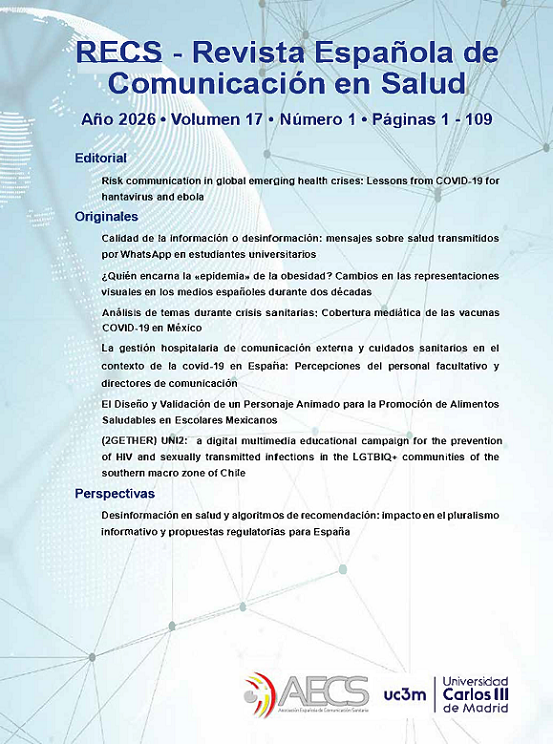
Downloads
Published
-
Abstract378
-
PDF 165
Issue
Section
License
Copyright (c) 2026 Anaid Guadalupe Martín-Díaz, Virginia Gabriela Aguilera-Cervantes, Fatima Ezzahra Housni, Patricia Núñez-Gómez, Yolanda Campos-Uscanga, Nora Edith Rangel-Bernal

This work is licensed under a Creative Commons Attribution-NoDerivatives 3.0 Unported License.
All articles published in this journal –unless otherwise stated- are distributed under the terms of the Creative Commons Attribution-NoDerives (CC-BY-ND 3.0 ES) Spain 3.0 License, which allows others to copy, distribute and transmit in a public way as long as they credit the author(s), journal and institution that publish these articles, and provided that they are not altered or modified. The complete license can be consulted in: https://creativecommons.org/licenses/by/3.0/es/deed/.es
The copyright belongs to the manuscript’s author just on the basis of creating this work:
- Moral rights are undeniable and inalienable.
- Economic or exploitation rights can be transferred to third parties, as it occurs when articles are published and authors partially or totally transfer their exploitation rights to publishers
Authors can archive their own articles in an institutional repository as long as their publications are cited in this journal.