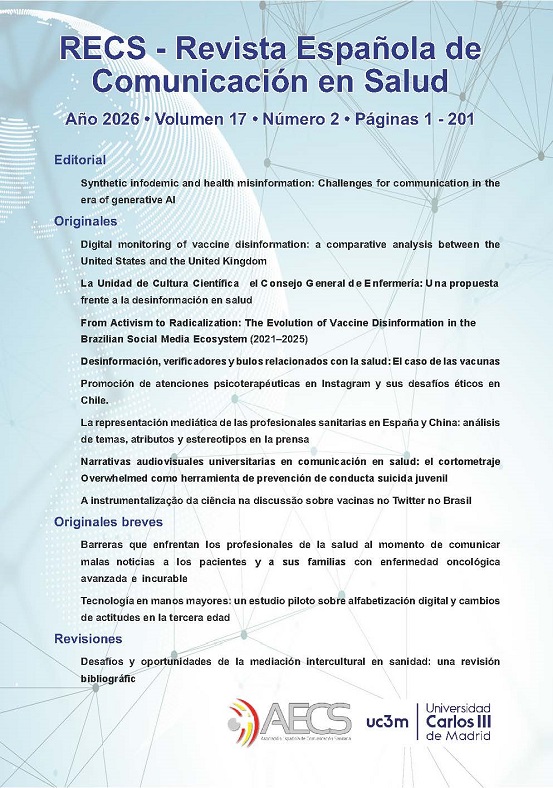
From Activism to Radicalization
The Evolution of Vaccine Disinformation in the Brazilian Social Media Ecosystem (2021–2025)
DOI:
https://doi.org/10.20318/recs.2026.9951Keywords:
Disinformation, Vaccination, Social Media, Immunization Programs, Public HealthAbstract
Introduction: This article analyzes the evolution of the vaccination discourse in Brazil on the X platform, comparing the civic mobilization of 2021 with the radicalization and collapse of dialogue observed in 2025. Objectives: To analyse “Platform Effect” as the central variable explaining the discursive shift over time. Methodology: A comparative-longitudinal approach was used, employing semantic network analysis and co-occurrence graphs to map narratives and ecosystems across both periods. Results: Findings indicate that in 2021, platform architecture reduced organizing costs (Shirky), facilitating pro-vaccine activism. In contrast, 2025 shows the consolidation of radical niches where disinformation is quantifiably relevant, attributed to the reversal of affordances. The algorithmic prioritization of conflict and emotional intensity elevated contestation costs for scientific voices (Gillespie), creating a discursive vacuum. The anti-vaccine discourse became a “cultural war” against the PNI. Conclusion: The fight against disinformation is inseparable from the debate on the regulation and design of digital architecture, given the severe threat to public health and democratic integrity.
Downloads
References
Bastian, M., Heymann, S., & Jacomy, M. (2009). Gephi: An open source software for exploring and manipulating networks. Proceedings of the International AAAI Conference on Web and Social Media, 3(1), 361–362.
Blondel, V. D., Guillaume, J.-L., Lambiotte, R., & Lefebvre, E. (2008). Fast unfolding of communities in large networks. Journal of Statistical Mechanics: Theory and Experiment, 2008(10), P10008. https://doi.org/10.1088/1742-5468/2008/10/P10008.
Campos, G. W. S. (2007). Um método para análise e co-gestão de coletivos [A method for the analysis and co-management of collectives] (3rd ed.). Hucitec.
Castells, M. (2015). Networks of outrage and hope: Social movements in the Internet age (2nd ed.). Polity Press. (Original work published 2012)
Chinazzo Müller, L. (2024a). Socialidade e desinformação: Análise de imaginários sobre as vacinas contra a Covid-19 no X (antigo Twitter) [Sociality and disinformation: Analysis of imaginaries about Covid-19 vaccines on X (formerly Twitter)] [Unpublished doctoral dissertation]. Pontifícia Universidade Católica do Rio Grande do Sul.
Chinazzo Müller, L. (2024b). Vitória da ciência e da saúde pública sobre a desinformação: Análise de imaginários no X (antigo Twitter) no início da vacinação contra a Covid-19 [Victory of science and public health over disinformation: Analysis of imaginaries on X at the beginning of Covid-19 vaccination]. Mídia e Cotidiano, 19(1), 131–141.
Fagá, I. V., Cyrino, A. P. P., & Teixeira, M. C. S. (2025). Implicações da infodemia de COVID-19 para a comunicação e divulgação científica. Revista Española de Comunicación en Salud, 16, 1–15. https://doi.org/10.20318/recs.2025.11142.
Fallis, D. (2011). Floridi on disinformation. Etica & Politica / Ethics & Politics, 2, 201–214.
Gillespie, T. (2010). The politics of “platforms.” New Media & Society, 12(3), 347–364. https://doi.org/10.1177/1461444809342738.
Jenkins, H., Ford, S., & Green, J. (2013). Spreadable media: Creating value and meaning in a networked culture. NYU Press.
Morejón-Llamas, N. (2023). Características y ejes discursivos de la desinformación y el proceso de fact-checking sobre las vacunas COVID-19 en Latinoamérica. Revista Española de Comunicación en Salud, 14(2), 1–15. https://doi.org/10.20318/recs.2023.7819.
Paim, J. S. (2018). Sistema Único de Saúde (SUS) aos 30 anos [The Unified Health System at 30 years]. Ciência & Saúde Coletiva, 23(6), 1723–1728. https://doi.org/10.1590/1413-81232018236.09172018.
Pan American Health Organization. (2020). Understanding the infodemic and misinformation in the fight against COVID-19. https://bit.ly/49wTESp.
Pariser, E. (2011). The filter bubble: What the Internet is hiding from you. Penguin Press.
Pasternak, N. (Ed.). (2025). VacinaBR yearbook 2025: Statistical report on vaccination in Brazil [E-book]. Instituto Questão de Ciência.
Przeworski, A., & Teune, H. (1970). The logic of comparative social inquiry. Wiley-Interscience.
Quandt, T. (2018). Dark participation. Media and Communication, 6(4), 36–48. https://doi.org/10.17645/mac.v6i4.1519.
Recuero, R. (2024). A rede da desinformação: Sistemas, estruturas e dinâmicas nas plataformas de mídias sociais [The disinformation network: Systems, structures and dynamics on social media platforms]. Sulina.
Schiavon, J., & Barcellos, C. (2021). Comunicação, emoção e ciência: Estratégias para promover a confiança pública na pandemia [Communication, emotion and science: Strategies to promote public trust during the pandemic]. Interface – Comunicação, Saúde, Educação, 25, e210129. https://doi.org/10.1590/interface.210129.
Shirky, C. (2009). Here comes everybody: The power of organizing without organizations. Penguin Books.
Van Dijck, J., Poell, T., & De Waal, M. (2018). The platform society: Public values in a connective world. Oxford University Press.
Wardle, C., & Derakhshan, H. (2017). Information disorder: Toward an interdisciplinary framework for research and policy making. Council of Europe.
Downloads
Published
-
Abstract95
-
PDF100
Issue
Section
License
Copyright (c) 2026 Luana Chinazzo, Anna Julia Teixeira de Oliveira, Lucas Bragança, Julia Firme, Fabio Goveia, Francis Sodré

This work is licensed under a Creative Commons Attribution-NoDerivatives 3.0 Unported License.
All articles published in this journal –unless otherwise stated- are distributed under the terms of the Creative Commons Attribution-NoDerives (CC-BY-ND 3.0 ES) Spain 3.0 License, which allows others to copy, distribute and transmit in a public way as long as they credit the author(s), journal and institution that publish these articles, and provided that they are not altered or modified. The complete license can be consulted in: https://creativecommons.org/licenses/by/3.0/es/deed/.es
The copyright belongs to the manuscript’s author just on the basis of creating this work:
- Moral rights are undeniable and inalienable.
- Economic or exploitation rights can be transferred to third parties, as it occurs when articles are published and authors partially or totally transfer their exploitation rights to publishers
Authors can archive their own articles in an institutional repository as long as their publications are cited in this journal.