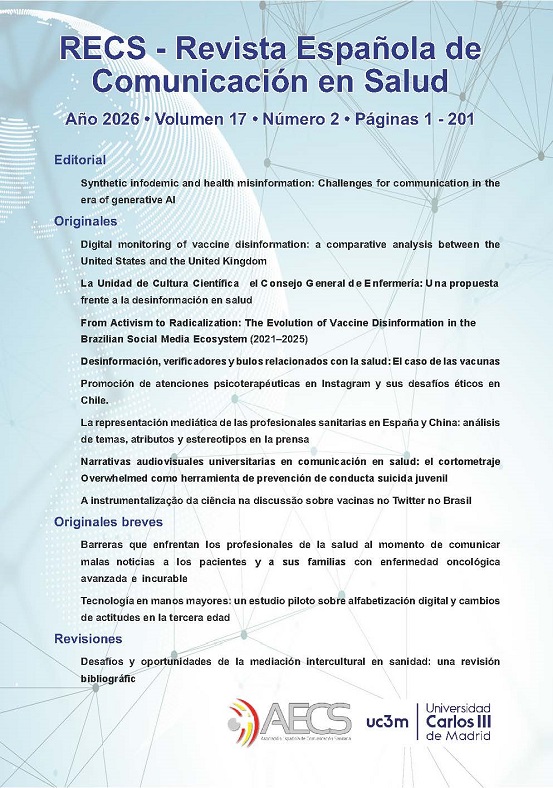
La representación mediática de las profesionales sanitarias en España y China
Análisis de temas, atributos y estereotipos en la prensa
DOI:
https://doi.org/10.20318/recs.2026.10114Palabras clave:
cobertura mediática, prensa, periódicos, trabajadoras sanitarias, estereotipos, España, ChinaResumen
Introducción: Las trabajadoras sanitarias constituyen la base del sistema de salud y desempeñan un papel esencial en el bienestar de la población. Sin embargo, su visibilidad mediática sigue siendo limitada. La forma en que los medios informan sobre ellas influye en el reconocimiento social y profesional que reciben. Objetivos: El estudio tiene como objetivo analizar el tratamiento informativo de las trabajadoras de la salud en los principales periódicos españoles y chinos. Metodología: Se llevó a cabo un análisis de contenido cuantitativo de 1.232 piezas periodísticas publicadas durante siete años en El País y ABC (España), y en People’s Daily y South China Morning Post (China). Resultados: Las trabajadoras sanitarias se asocian con mayor frecuencia que los hombres a atributos maternales, físicos y emocionales. Por su parte, la prensa china enfatiza más sus atributos físicos, mientras que la española destaca con mayor frecuencia sus conocimientos profesionales. Conclusión: Los estereotipos de género tienen una presencia destacada en la representación del personal sanitario femenino por parte de los periódicos españoles y chinos, de modo que estos estereotipos continúan condicionando tanto su visibilidad como el reconocimiento de sus competencias sanitarias.
Descargas
Referencias
Ardévol-Abreu, A. (2015). Framing theory in communication research: Origins, development and current situation in Spain. Revista Latina de Comunicación Social, 70(4), 423–450. https://doi.org/10.4185/RLCS-2015-1053
Aruguete, N. (2010). Estableciendo la agenda: Los orígenes y la evolución de la teoría de la agenda setting. Ecos de la Comunicación, 2(2), 11–38. https://repositorio.uca.edu.ar/handle/123456789/7119
Bagnasco, A., Catania, G., Gallagher, A., & Morley, G. (2020). Media representations of nurses in the pandemic: Just doing our job? Nursing Ethics, 27(4), 901–905. https://doi.org/10.1177/0969733020926352
Bateson, G. A. (1955/1972). A theory of play and fantasy. En G. A. Bateson (Ed.), Steps to an ecology of mind (reimpreso de American Psychiatric Association Research Reports, 1955, II, 1939–1951). Chandler.
Bauer, N. M., & Taylor, T. (2023). Selling them short? Differences in news coverage of female and male candidate qualifications. Political Research Quarterly, 76(1), 308–322. https://doi.org/10.1177/10659129221086024
Begnini, D., Cicolella, D. A., Freitas, K. R., Maranhão, T., Rocha, C. M. F., & Kruse, M. H. L. (2021). Heroines in COVID-19 times: Visibility of nursing in the pandemic. Revista Gaúcha de Enfermagem, 42(spe), e20200373. https://doi.org/10.1590/1983-1447.2021.20200373
Bennett, C. L., James, A. H., & Kelly, D. (2020). Beyond tropes: Towards a new image of nursing in the wake of COVID-19. Journal of Clinical Nursing, 29(15–16), 2753–2755. https://doi.org/10.1111/jocn.15346
Borger, J. G., Longley, R. J., Taylor, M. F., Motrich, R., Payne, J. A., & Kemp, R. A. (2025). Global perspectives to enhance strategies for advancing women in healthcare and STEMM leadership. Immunology and Cell Biology, 103(3), 234–250. https://doi.org/10.1111/imcb.12854
Burrell, D. N., Burton, S. L., Springs, D., Sabie-Aridi, A., & Mondala-Duncan, M. R. (2024). Developing women in hospital, academic medical center, and healthcare management. Brazilian Journal of Business, 6(3). https://doi.org/10.34140/bjbv6n3-032
Cao, H. (2022). Hiding women healthcare workers in the media spotlight: How the Chinese state media represented women HCWs in response to the COVID-19-engendered crises. Feminist Media Studies, 23(3), 918–936. https://doi.org/10.1080/14680777.2021.2018009
Chen, B., & Koo, G. (2022). Journalistic roles and news framing: A comparative framing analysis of COVID-19 pandemic across China, South Korea, and the United States. International Journal of Communication, 16, 21. https://ijoc.org/index.php/ijoc/article/view/19479/3879
Chen, X., Du, Y., Shen, Z., Qin, W., & Zhang, Y. (2024). How the public perceives the “good nurse” in China: A content analysis of national newspapers. Journal of Nursing Scholarship, 56(1), 164–173. https://doi.org/10.1111/jnu.12928
Cheng, Y. (2024). The influence of Confucianism on the role of women in the new era. Journal of Education, Humanities and Social Sciences, 42, 36–40. https://doi.org/10.54097/vzpvaf70
Dolcini, N., & Valle, V. (2024). Heroines in the east and the west: A comparative semiotic study of female imagery in the anti-pandemic discourse of Italy and China. Chinese Semiotic Studies, 20(4), 647–666. https://doi.org/10.1515/css-2024-2031
Domínguez, M., & Sapiña, L. (2022). She-Coronavirus: How cartoonists reflected women health workers during the COVID-19 pandemic. European Journal of Women’s Studies, 29(2), 282–297. https://doi.org/10.1177/13505068211048402
Eckert, P., & McConnell-Ginet, S. (2013). Language and gender (2nd ed.). Cambridge University Press.
Entman, R. M. (1993). Framing: Toward clarification of a fractured paradigm. Journal of Communication, 43(4), 51–58. https://doi.org/10.1111/j.1460-2466.1993.tb01304.x
Foà, C., Bertuol, M., Baronchelli, E., Beltrami, G., Toninelli, S., Zamboni, L., & Artioli, G. (2021). The influence of media representations on citizens’ perceptions towards nurses: A comparison between before and after the COVID-19 pandemic. Acta Bio-Medica: Atenei Parmensis, 92(S2), e2021429. https://doi.org/10.23750/abm.v92iS2.12614
Gao, C., Yi, H., Wang, J., & Han, S. (2023). Framing of female medical personnel during the COVID-19 pandemic: A case study of the Chinese official media. Humanities and Social Sciences Communications, 10(1), 249. https://doi.org/10.1057/s41599-023-01749-0
Gao, J. (2023). The discourse construction of the image of medical workers in news discourse. International Journal of Frontiers in Sociology, 5(8), 138–144. https://doi.org/10.25236/IJFS.2023.050822
García Beaudoux, V., D’Adamo, O., & Gavensky, M. (2018). Una tipología de los sesgos y estereotipos de género en la cobertura periodística de las mujeres candidatas. Revista Mexicana de Opinión Pública, (24), 113–129. https://doi.org/10.22201/fcpys.24484911e.2018.24.61614
Gill, J., & Baker, C. (2021). The power of mass media and feminism in the evolution of nursing’s image: A critical review of the literature and implications for nursing practice. The Journal of Medical Humanities, 42(3), 371–386. https://doi.org/10.1007/s10912-019-09578-6
Gong, W., Tu, C., & Jiang, L. C. (2017). Stigmatized portrayals of single women: A content analysis of news coverage on single women and single men in China. Journal of Gender Studies, 26(2), 197–211. https://doi.org/10.1080/09589236.2015.1095082
González-Luis, H., Gómez-Baceiredo, B., Errasti-Ibarrondo, B., Choperena, A., Díaz-Suárez, I., Alfaro, A., & Pérez-Acuña, C. (2024). ¿Cambió la pandemia la imagen de las enfermeras españolas? Identidad enfermera y voz como fuentes informativas. Enfermería Nefrológica, 27(3), 255–270. https://doi.org/10.37551/s2254-28842024027
Hennein, R., Gorman, H., Chung, V., & Lowe, S. R. (2023). Gender discrimination among women healthcare workers during the COVID-19 pandemic: Findings from a mixed methods study. PLOS ONE, 18(2), e0281367. https://doi.org/10.1371/journal.pone.0281367
Hoeve, Y., Jansen, G., & Roodbol, P. (2014). The nursing profession: Public image, self-concept and professional identity. Journal of Advanced Nursing, 70(2), 295–309. https://doi.org/10.1111/jan.12177
Humanes, M. L., & Nicolás, M. M. (2017). La cobertura de la política durante la transición en los diarios El País y ABC. Periodística: Revista Académica, (16), 71–89. https://raco.cat/index.php/Periodistica/article/view/321207
Jamieson, K. H. (1995). Beyond the double bind: Women and leadership. Oxford University Press.
Javed, B., Sarwer, A., Soto, E. B., & Mashwani, Z. U. (2020). Impact of SARS-CoV-2 (coronavirus) pandemic on public mental health. Frontiers in Public Health, 8, 292. https://doi.org/10.3389/fpubh.2020.00292
Kluge, H., & Azzopardi-Muscat, N. (2023). The health workforce crisis in Europe is also a gender equality crisis. BMJ (Clinical Research Ed.), 380, 554. https://doi.org/10.1136/bmj.p554
Lobo, P., & Cabecinhas, R. (2018). Retratos de género nas notícias televisivas: Uma análise das desigualdades por detrás da representação numérica. Estudos em Comunicação, 26(1), 81–99. https://doi.org/10.20287/ec.n26.v1.a06
Lock, I., & Seele, P. (2015). Quantitative content analysis as a method for business ethics research. Business Ethics: A European Review, 24(S1), S24–S40. https://doi.org/10.1111/beer.12095
Martínez-Rodríguez, L., Muñoz-Devesa, A., & Tejero-Vidal, L. L. (2022). Construcción de la imagen profesional de enfermería durante la pandemia por COVID-19 a través de las noticias de prensa. Index de Enfermería, 31(3), 151–155. http://scielo.isciii.es/scielo.php?script=sci_arttext&pid=S1132-12962022000300003
Meehan, T. C., Timmins, F., & Burke, J. (2018). Fundamental care guided by the Careful Nursing philosophy and professional practice model©. Journal of Clinical Nursing, 27(11–12), 2260–2273. https://doi.org/10.1111/jocn.14303
Mohammed, S., Peter, E., Killackey, T., & Maciver, J. (2021). The “nurse as hero” discourse in the COVID-19 pandemic: A poststructural discourse analysis. International Journal of Nursing Studies, 117, 103887. https://doi.org/10.1016/j.ijnurstu.2021.103887
Moreno-Espinosa, P., Contreras Orozco, J.-H., & Román-San-Miguel, A. (2021). Medios de comunicación, redes sociales y virus del miedo durante la pandemia de COVID-19. Ámbitos. Revista Internacional de Comunicación, 53, 148–160. https://doi.org/10.12795/Ambitos.2021.i53.08
Moudatsou, M., Stavropoulou, A., Philalithis, A., & Koukouli, S. (2020). The role of empathy in health and social care professionals. Healthcare, 8(1), 26. https://doi.org/10.3390/healthcare8010026
Nash, M. (2006). Identidades de género, mecanismos de subalternidad y procesos de emancipación femenina. Revista CIDOB d’afers internacionals, 73, 39–57. https://raco.cat/index.php/RevistaCIDOB/article/view/40380
Noetzel, S., Mussalem Gentile, M. F., Lowery, G., Zemanova, S., Lecheler, S., & Peter, C. (2023). Social campaigns to social change? Sexual violence framing in U.S. news before and after #MeToo. Journalism, 24(6), 1232–1262. https://doi.org/10.1177/14648849211056386
Park, D., Kim, D., & Park, A. H. (2024). Agendas on nursing in South Korea media: Natural language processing and network analysis of news from 2005 to 2022. Journal of Medical Internet Research, 26, e50518. https://doi.org/10.2196/50518
Parratt Fernández, S., Mera Fernández, M., & Carrasco Polaino, R. (2020). La relevancia del cambio climático en la prensa española: análisis comparativo de El País, El Mundo y ABC. Revista OBETS, 15(2), 625–648. https://doi.org/10.14198/OBETS2020.15.2.09
Pincha Baduge, M. S. S., Garth, B., Boyd, L., Ward, K., Joseph, K., Proimos, J., & Teede, H. J. (2023). Barriers to advancing women nurses in healthcare leadership: A systematic review and meta-synthesis. EClinicalMedicine, 67, 102354. https://doi.org/10.1016/j.eclinm.2023.102354
Plaza, J. F., & Delgado, C. (Eds.). (2007). Género y comunicación (Vol. 303). Editorial Fundamentos.
Preti, E., Di Mattei, V., Perego, G., Ferrari, F., Mazzetti, M., Taranto, P., Di Pierro, R., Madeddu, F., & Calati, R. (2020). The psychological impact of epidemic and pandemic outbreaks on healthcare workers: Rapid review of the evidence. Current Psychiatry Reports, 22(8), 43. https://doi.org/10.1007/s11920-020-01166-z
Proimos, J., Boyle, J. A., Garth, B., Loh, E., & Teede, H. J. (2024). The role of medical colleges and member organisations in advancing women in health care leadership. The Medical Journal of Australia, 220(7), 346–351. https://doi.org/10.5694/mja2.52244
Raman, U., & Kasturi, S. (2023). The frontlines and margins: Gendered care and COVID-19 in the Indian media. Media and Communication, 11(1), 102–113. https://doi.org/10.17645/mac.v11i1.6104
Reißmann, W., Siemon, M., Lünenborg, M., & Raetzsch, C. (2023). Making (female) health care work matter: The performative publics of #systemrelevant during the COVID-19 pandemic in Germany. MedieKultur: Journal of Media and Communication Research, 38(73), 073–099. https://doi.org/10.7146/mk.v38i73.128451
Sabetsarvestani, R., Geçkil, E., & Shirazi, Z. H. (2022). Dedication in nursing: A concept analysis. Nursing and Midwifery Studies, 11(1), 62–70. https://doi.org/10.4103/nms.nms_52_21
Santos, V. P. F. A., Sant’Anna, M. V., Padilha, M. I., Porto, F. R., Luchesi, L. B., & Silva, G. T. R. D. (2025). Representation of female nurses in journalistic texts in Bahia from 1936 to 1956. Revista da Escola de Enfermagem da USP, 59, e20240199. https://doi.org/10.1590/1980-220X-REEUSP-2024-0199en
Semetko, H. A., & Valkenburg, P. M. (2000). Framing European politics: A content analysis of press and television news. Journal of Communication, 50(2), 93–109. https://doi.org/10.1111/j.1460-2466.2000.tb02843.x
Sun, X., & Chałupnik, M. (2022). Sacrificing long hair and the domestic sphere: Reporting on female medical workers in Chinese online news during COVID-19. Discourse & Society, 33(5), 650–670. https://doi.org/10.1177/09579265221096029
Teresa-Morales, C., Rodríguez-Pérez, M., Araujo-Hernández, M., & Feria-Ramírez, C. (2022). Current stereotypes associated with nursing and nursing professionals: An integrative review. International Journal of Environmental Research and Public Health, 19(13), 7640. https://doi.org/10.3390/ijerph19137640
Thomas, M., Harell, A., Rijkhoff, S. A. M., & Gosselin, T. (2021). Gendered news coverage and women as heads of government. Political Communication, 38(4), 388–406. https://doi.org/10.1080/10584609.2020.1784326
Vai, A., Setiawan, C., Ngatman, N., Lardika, R. A., Noviana, E., Yusuf, J., … Desviyanti, E. (2025). Analysis of the representation of female athletes in sports media: A systematic literature review. Retos, 63, 918–927. https://doi.org/10.47197/retos.v63.109449
Van der Pas, D. J., & Aaldering, L. (2020). Gender differences in political media coverage: A meta-analysis. Journal of Communication, 70(1), 114–143. https://doi.org/10.1093/joc/jqz046
van Wijk, J., van Loon, F. H. J., Hendrickx, F., Arets, D., & Lalleman, P. C. B. (2025). Finding the voices: Representation of nurses in Dutch newspaper media between 2019 and 2022. International Nursing Review, 72(3), e70097. https://doi.org/10.1111/inr.70097
Van Zoonen, L. (1994). Feminist media studies. SAGE Publications
Wang, H., Sparks, C., & Huang, Y. (2018). Measuring differences in the Chinese press: A study of People’s Daily and Southern Metropolitan Daily. Global Media and China, 3(3), 125–140. https://doi.org/10.1177/2059436418806022
Wegner, J. (2025). Televisual inequalities and gender dynamics in German news: Health experts during the COVID-19 crisis. Media and Communication, 13. https://doi.org/10.17645/mac
Wiebrecht, F. (2018). Cultural co-orientation revisited: The case of the South China Morning Post. Global Media and China, 3(1), 32–50. https://doi.org/10.1177/2059436418778306
Yang, Y., & Liu, X. (2021). Reporting strategy and gender perspective in Chinese media coverage of COVID-19 news. Journalism and Media, 2(3), 416–431. https://doi.org/10.3390/journalmedia2030021
Descargas
Publicado
-
Resumen148
-
PDF84
Número
Sección
Licencia
Derechos de autor 2026 Xingyue Zhang, María-Ángeles Chaparro-Domínguez, Francisco Segado-Boja

Esta obra está bajo una licencia Creative Commons Reconocimiento-SinObraDerivada 3.0 Unported.
Los textos publicados en esta revista están –si no se indica lo contrario– bajo una licencia Reconocimiento-Sin obras derivadas 3.0 España de Creative Commons. Puede copiarlos, distribuirlos y comunicarlos públicamente siempre que cite su autor y la revista y la institución que los publica y no haga con ellos obras derivadas. La licencia completa se puede consultar en: http://creativecommons.org/licenses/by-nd/3.0/es/deed.es
Los derechos de autor pertenecen al autor de la obra por el mero hecho de su creación:
· Los derechos de contenido moral son irrenunciables e inalienables.
· Los derechos de contenido económico, o derechos de explotación, pueden ser cedidos a terceros como ocurre con los trabajos publicados, en los que el autor cede parte o la totalidad de estos derechos a la editorial.
El autor puede autoarchivar sus artículos en un repositorio institucional, siempre que se cite su publicación en esta revista.