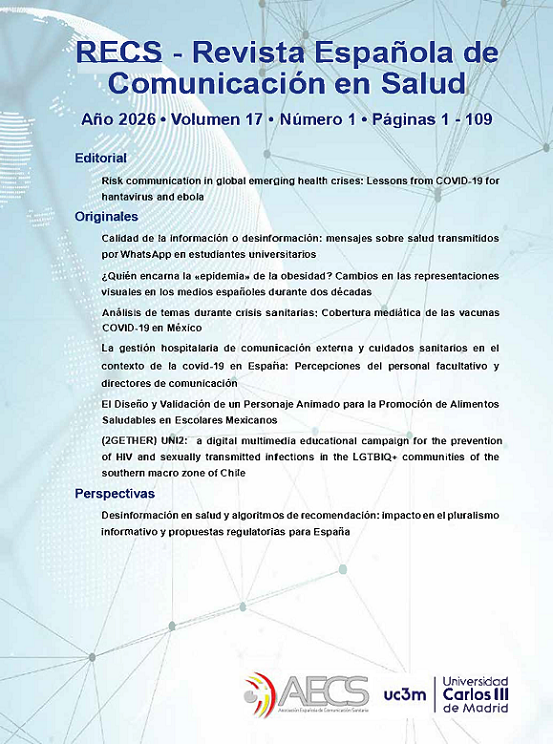
¿Quién encarna la «epidemia» de la obesidad?
Cambios en las representaciones visuales en los medios españoles durante dos décadas
DOI:
https://doi.org/10.20318/recs.2026.10177Palabras clave:
Obesidad, medios de comunicación, imágenes, representación, estigmaResumen
Introducción: Este estudio analiza la cobertura mediática de la obesidad en la prensa española desde una perspectiva visual, examinando no solo cómo se enmarca la obesidad como epidemia, sino también cómo se representan los cuerpos asociados a esta problemática en dos periodos (2000–2005 y 2015–2020). Metodología: Se realizó un análisis de contenido de una muestra de 149 noticias publicadas en la prensa española en ambos periodos. El estudio codificó las características de las personas representadas en las imágenes, considerando género, edad, tipo de cuerpo y actividades asociadas. Resultados: Los hallazgos indican que, mientras que en el primer periodo existe una representación equilibrada de hombres y mujeres, en el segundo aumenta la presencia de hombres, especialmente adultos. Existen algunos avances en diversidad visual, aunque la imaginería sigue siendo estigmatizante, particularmente debido a la persistencia del tropo del «gordo descabezado». Asimismo, emerge un patrón paradójico: las actividades vinculadas a estereotipos negativos sobre la gordura se representan con mayor frecuencia mediante cuerpos de peso considerado normal. Conclusiones: La cobertura visual no solo cumple una función ilustrativa, sino que actúa como un dispositivo normativo que reproduce estereotipos y refuerza discursos estigmatizantes sobre el cuerpo, la salud y la responsabilidad individual.
Descargas
Referencias
Abrante, D., and Carballeira, M. (2023). Self-Exposure on Instagram and BMI: Relations With Body Image Among Both Genders. Europe’s Journal of Psychology, 19, 180 - 191. https://doi.org/10.5964/ejop.7221
Agencia Española de seguridad Alimentaria y Nutrición (Ministerio de Consumo) – Centro Nacional de Epidemiología (Instituto de Salud Carlos III). (2023). ENE-COVID: Situación ponderal de la población infantil y adolescente en España. (Informe). Recuperado de : https://www.aesan.gob.es/AECOSAN/docs/documentos/nutricion/ENE_COVID_NINOS_FINAL.pdf
Aiman, U., Mylavarapu, M., Gohil, N., Holge, S., Gajre, A., Akhila, K., and Ghadge, N. (2023). Obesity: An Instagram Analysis. Cureus, 15. https://doi.org/10.7759/cureus.39619
Aranceta-Bartrina, J., Pérez-Rodrigo, C., Alberdi-Aresti, G., Ramos-Carrera, N., and Lázaro-Masedo, S. (2016). Prevalencia de obesidad general y obesidad abdominal en la población adulta española (25–64 años) 2014–2015: estudio ENPE. Revista Española de Cardiología, 69(12), 579–587. https://doi.org/10.1016/j.recesp.2016.02.010
Armentia, J. I., and Marín, F. (2020). How the Spanish press frames obesity: A study of content published by El País, La Vanguardia , and El Correo in 2015. Journalism, 21(12), 1932–1950. https://doi.org/10.1177/1464884918754851
Argiñano, J. L., and Gurrutxaga-Rekondo, G. (2024). La obesidad en los ciberdiarios españoles: de la estigmatización (del obeso) a la responsabilidad social y a las soluciones estructurales. Revista Mediterránea de Comunicación, 15(1), 323-339. https://www.doi.org/10.14198/MEDCOM.24327
Atanasova, D., Gunter, B., and Koteyko, N. (2012). Ways of seeing obesity: A visual content analysis of British and German online newspapers. The International Journal of Communication and Health, 1–8.
Atanasova, D., and Koteyko, N. (2017). Obesity frames and counter-frames in British and German online newspapers. Health, 21(6), 650–669. https://doi.org/10.1177/1363459316649764
Baker, P., Brookes, G., Atanasova, D., and Flint, S. (2020). Changing frames of obesity in the UK press 2008-2017. Social Science and Medicine, 264, 113403. https://doi.org/10.1016/j.socscimed.2020.113403.
Bonfiglioli, C. (2015). Overweight and Obesity in TV News. En Values and Choices in Television Discourse: A View from Both Sides of the Screen (pp. 87–108). Springer.
Bonfiglioli, C., and Cullen, T. (2017). Health journalism - evolution and innovation in the digital age. Australian Journalism Review, 39(2), 13–22. https://search.informit.org/doi/10.3316/informit.360223991370243
Brookes, G., and Baker, P. (2021). Obesity in the News. Cambridge University Press https://doi.org/10.1017/9781108864732.
Cain, P., Donaghue, N., and Ditchburn, G. (2017). Concerns, culprits, counsel, and conflict: A thematic analysis of “obesity” and fat discourse in digital news media. Fat Studies, 6(2), 170–188. https://doi.org/10.1080/21604851.2017.1244418
Camacho Markina, I., Goikoetxea Bilbao, U., and Marauri Castillo, I. (2023). Estigmatización social en el tratamiento informativo de la obesidad en la prensa española durante la pandemia. Revista Latina de Comunicación Social, 81, 308–331. https://doi.org/10.4185/RLCS-2023-1895
Ekman, A. (2023). Theorising Fatness as an Ordering Issue: A Conceptual Framework for Analysing the Construction of Fatness as Disorder. Body and Society, 29(4), 79-104. https://doi.org/10.1177/1357034X231187973
Gard, M., and Wright, J. (2005). The obesity epidemic: Science, morality and ideology. Routledge. Gollust, S. E., Eboh, I., and Barry, C. L. (2012). Picturing obesity: Analyzing the social epidemiology of obesity conveyed through US news media images. Social Science and Medicine, 74(10), 1544-1551. https://doi.org/10.1016/j.socscimed.2012.01.021
Heuer, C. A., McClure, K. J., and Puhl, R. M. (2011). Obesity Stigma in Online News: A Visual Content Analysis. Journal of Health Communication, 16(9), 976–987. https://doi.org/10.1080/10810730.2011.561915
Hilton, S., Patterson, C., and Teyhan, A. (2012). Escalating coverage of obesity in UK newspapers: The evolution and framing of the obesity epidemic from 1996 to 2010. Obesity, 20(8), 1688-1695. https://doi.org/10.1038/oby.2012.27
Hooft, J., Patterson, C., Löf, M., Alexandrou, C., Hilton, S., and Nimegeer, A. (2018). Media framing and construction of childhood obesity: a content analysis of Swedish newspapers. Obesity Science and Practice, 4, 4-13. https://doi.org/10.1002/osp4.150.
Idoyaga, N., Francisco Valencia, J., Gil de Montes, L., and Ortiz, G. (2012). Efectos del Framing y representaciones sociales de epidemias sanitarias: El Caso de la Gripe A. Escritos de Psicología (Internet), 5(3), 31-42. https://doi.org/10.5231/psy.writ.2012.0211
Jeon, Y., Koh, H., Ahn, J., and Coleman, R. (2019). Stigma activation through dis-identification: cognitive bias triggered by mass media photos of people with obesity. Journal of Applied Communication Research, 47, 485 - 504. https://doi.org/10.1080/00909 882.2019.1682181.
Lisser, I., and Smaele, H. (2020). Faceless: The visual representation of overweight people in Flemish and Dutch online newspapers. World of Media 2, 5-19. https://doi.org/10.30547/worldofmedia.2.2020.1
Lupton, D. (2018). ‘I Just Want It to Be Done, Done, Done!’ Food Tracking Apps, Affects, and Agential Capacities. Multimodal Technologies and Interaction, 2(2), 29. https://doi.org/10.3390/mti2020029
Marín-Murillo, F., Marauri-Castillo, I., and Rodríguez-González, M. M. (2024). Childhood Obesity in the Spanish Digital Press: A Social Problem with Individual Causes and Consequences. Profesional de la información, 33(1). https://doi.org/10.3145/epi.2024.0008
Martin-Vicario, L., Bustos Díaz, J., & Nicolas-Sans, R. (2024). Evolution of the obesity epidemic in the Spanish press: A comparative study 2000–05 and 2015–20. Catalan Journal of Communication & Cultural Studies, 16(1), 25-44. https://doi.org/10.1386/cjcs_00097_1
Miralles, M., Chilet-Rosell, E., and Hernández-Aguado, I. (2021). Encuadre mediático de la obesidad infantil en las noticias de prensa generalista en España. Gaceta Sanitaria, 35(3), 256–259. https://doi.org/10.1016/j.gaceta.2019.09.010
Monaghan, L. F., Hollands, R., and Prtichard, G. (2010). Obesity Epidemic Entrepreneurs: Types, Practices and Interests. Body and Society, 16(2), 37–71. https://doi.org/10.1177/1357034X10364769
Monaghan, L. F., Rich, E., and Bombak, A. E. (2022). Rethinking obesity: critical perspectives in crisis times. Routledge. Mouzo, J. (2023, November 23) Radiografía de la obesidad en España: más de la mitad de los adultos y un tercio de los niños tienen exceso de peso. El País. https://elpais.com
Nettleton, S. (2020). The sociology of health and illness. John Wiley and Sons.
Nimegeer, A., Patterson, C., and Hilton, S. (2019). Media framing of childhood obesity: a content analysis of UK newspapers from 1996 to 2014. BMJ Open, 9. https://doi.org/10.1136/bmjopen-2018-025646.
O’Hara, L., and Taylor, J. (2018). What’s Wrong With the ‘War on Obesity?’ A Narrative Review of the Weight-Centered Health Paradigm and Development of the 3C Framework to Build Critical Competency for a Paradigm Shift. SAGE Open, 8(2). https://doi.org/10.1177/2158244018772888
Oller Alonso, M. (2014). The triangle formed by framing, agenda setting and metacoverage. Disertaciones: Anuario Electrónico de Estudios En Comunicación Social, 7(1), 41–46. Recuperado de : http://erevistas.saber.ula.ve/index.php/Disertaciones/article/view/4423
Previte, J., and Gurrieri, L. (2015). Who Is the Biggest Loser? Fat News Coverage Is a Barrier to Healthy Lifestyle Promotion. Health Marketing Quarterly, 32(4), 330–349. https://doi.org/10.1080/07359683.2015.1093881
Puhl, R.M., Luedicke, J. and Heuer, C.A., 2013. The stigmatizing effect of visual media portrayals of obese persons on public attitudes: does race or gender matter?. Journal of Health Communication, 18(7), pp.805-826. https://doi.org/10.1080/10810730. 2012.757393
Rao, A., Puhl, R., and Farrar, K. (2023). Weight Stigma in Online News Images: A Visual Content Analysis of Stigma Communication in the Depictions of Individuals with Obesity in U.S. and U.K. News. Journal of Health Communication, 29(2), 95–106. https://doi.org/10.1080/10810730.2023.2286512
Rose, G. (2012). Visual Methodologies: An Introduction to Researching with Visual Materials. Sage. Rose, N. (1999). Powers of freedom: Reframing political thought. Cambridge UP.
Saguy, A. C., Gruys, K., and Gong, S. (2010). Social Problem Construction and National Context: News Reporting on “Overweight” and “Obesity” in the United States and France. Social Problems, 57(4), 586–610. https://doi.org/10.1525/sp.2010.57.4.586
Saguy, A. (2013). What’s wrong with fat? Oxford University Press (UK). Varava, K. (2016). Visual Framing, Stigmatization, Race, and Obesity: Examining Television News Presentation of Stories about Obesity and Stories about Health. Communication Studies, 67(5), 509-529. https://doi.org/10.1080/10510974.2016.1236348
WHO. (2000). Obesity: preventing and managing the global epidemic. World Health Organization - Technical Report Series, 1–268. https://doi.org/10.1016/S0140-6736(03)15268-3
Descargas
Publicado
-
Resumen223
-
PDF125
Número
Sección
Licencia
Derechos de autor 2026 Lara Martín Vicario, Javier Bustos Díaz, Marta Gil Ibáñez

Esta obra está bajo una licencia Creative Commons Reconocimiento-SinObraDerivada 3.0 Unported.
Los textos publicados en esta revista están –si no se indica lo contrario– bajo una licencia Reconocimiento-Sin obras derivadas 3.0 España de Creative Commons. Puede copiarlos, distribuirlos y comunicarlos públicamente siempre que cite su autor y la revista y la institución que los publica y no haga con ellos obras derivadas. La licencia completa se puede consultar en: http://creativecommons.org/licenses/by-nd/3.0/es/deed.es
Los derechos de autor pertenecen al autor de la obra por el mero hecho de su creación:
· Los derechos de contenido moral son irrenunciables e inalienables.
· Los derechos de contenido económico, o derechos de explotación, pueden ser cedidos a terceros como ocurre con los trabajos publicados, en los que el autor cede parte o la totalidad de estos derechos a la editorial.
El autor puede autoarchivar sus artículos en un repositorio institucional, siempre que se cite su publicación en esta revista.